The problem: You optimized your body for an audience that does not exist, and now you cannot enjoy it for yourself.
The trap of optimization is that it promises freedom and delivers the opposite. You are going to be free when you have the right body, the right routine, the right supplement stack. But the body keeps changing the target. Muscle was the goal. Then it was vascularity. Then it was a specific body-fat percentage. Then it was the ability to do something impressive at the gym that would make other people notice.
By the time you notice it, the body has become not a tool for living, but an object for judgment. And the judgment never stops because judgment was never the real audience. The real audience is the man in the mirror telling you that you should look different than you do.
The pursuit became the problem
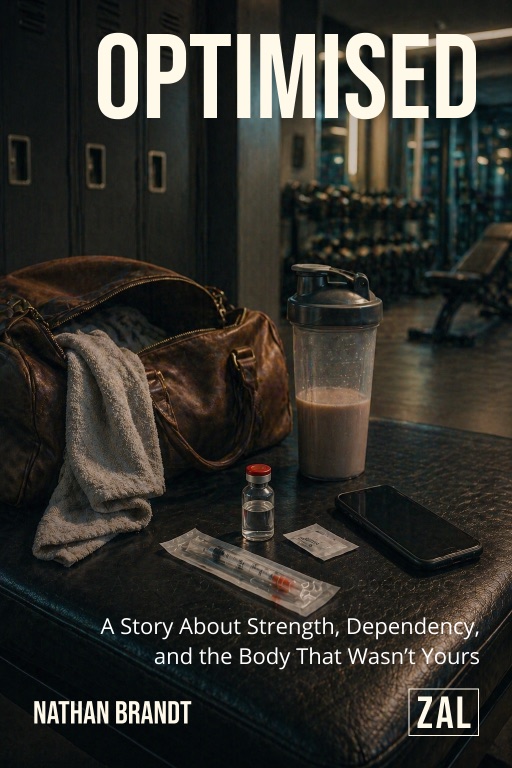
Lee in Optimised knows this trap well. He has chased the image so long that he has forgotten what his body was actually for. It was for feeling capable. For moving without pain. For sleeping. For sex. For existing in a life without constant measurement.
Optimization took all of that and turned it into a spreadsheet. The body became data. Macros, calories, metrics, before and after photos, comparisons to men online who are also optimizing for a phantom audience.
The cost is real. The constant assessment means you cannot inhabit your body anymore. You are always standing outside it, measuring it, finding it inadequate. Even when you reach the goal, the goal has already moved. You hit 8% body fat and now you want 7%. You add ten pounds of muscle and now you want another ten. There is no finish line. There is only the perpetual state of not being there yet.
The invisible cost
What does not show up in the metrics is the cost to the other parts of your life. You cannot spontaneously go out for a meal because it throws off your macros. You cannot relax on the weekend because you have to stay disciplined. You cannot have sex without thinking about whether you have eaten enough protein. You cannot rest without guilt.
The body was supposed to be the foundation of a life. Instead, the life has become the thing that supports the body’s optimization.
Reclaiming means deciding what it’s for
The way out is not abandonment. It is reclamation. But reclamation requires you to answer a harder question than optimization ever asked: what is your body for? Not for other people’s eyes. Not for the scoreboard. For you. In private. In a life that is actually yours.
Most men have forgotten the answer. The body was for walking into the world without thinking about how it looked. It was for sex that was not performance. It was for feeling strong without needing to prove it. It was for sitting in a chair without calculating body-fat percentage. It was for simply existing.
Reclaiming that requires you to make choices that optimization taught you to see as failure. Maybe you stop counting macros. Maybe you train because it feels good, not because you have a number to hit. Maybe you notice that you actually do not want to look like the men in the photos because those men have left their entire lives to the gym. Maybe you want to go to your friend’s wedding without calculating whether you will stay lean enough. Maybe you want to eat pasta without tracking it.
The fear underneath
The fear that usually stops men from reclaiming is this: if I stop optimizing, I will fall apart. If I stop tracking my macros, I will gain thirty pounds. If I stop training with discipline, I will lose all my progress. If I let myself relax about my appearance, I will become invisible.
Sometimes these fears are real. Sometimes the optimization was covering up a deeper insecurity about being worthy at all. And sometimes the optimization was solving for the wrong problem. You were trying to become impressive instead of trying to become inhabitable.
The question is: which version of yourself actually wants to live? The man who has a good body but lives for the body? Or the man who has a good enough body and lives for everything else?
One small thing to try
The practical move is small. One week, do one thing with your body that is purely for yourself. Not because it will be measured. Not because anyone will see. Not because it fits the plan. Walk somewhere beautiful. Play a sport you liked once. Swim. Dance. Make love without thinking about whether you are lean enough. Move your body in a way that reminds you it is yours, not a project.
Notice what you notice. Does it feel different to move when you are not measuring? Does it feel different to eat something because you want it instead of because it fits the macros? Does it feel different to rest without guilt? Does the world actually fall apart? Or does something quieter happen—a small peace, a brief rest from the constant evaluation?
That is not laziness. That is returning to the point. The body was the tool. The optimization became the point. Getting the point back requires you to stop serving the measurement and start serving the man.
What Optimised shows
Optimised shows what happens when someone finally allows himself to want something different. It is not dramatic. It is not a sudden rejection of health or strength or discipline. It is just reclaiming the right to want without needing to justify it. The right to change. The right to be done. The right to have a body that serves your life instead of a life that serves your body.
And what you discover, once you stop measuring, is that you were strong enough all along. The body was never the problem. The relationship to the body was.
One thing to try
Ask one question: what would I do with my body if nobody would ever know about it? Start there.
A sentence you can use
I'm giving myself permission to want different things from my body than I used to. That's not failure. That's honesty.
Where to go next
If this is the room you are in, start with the book that goes deeper into the pattern without turning it into a performance. Start with Optimised.