
Nine books · Problem-led essays For men who are tired of performing fine. Zero-Audience Library · MMXXVI
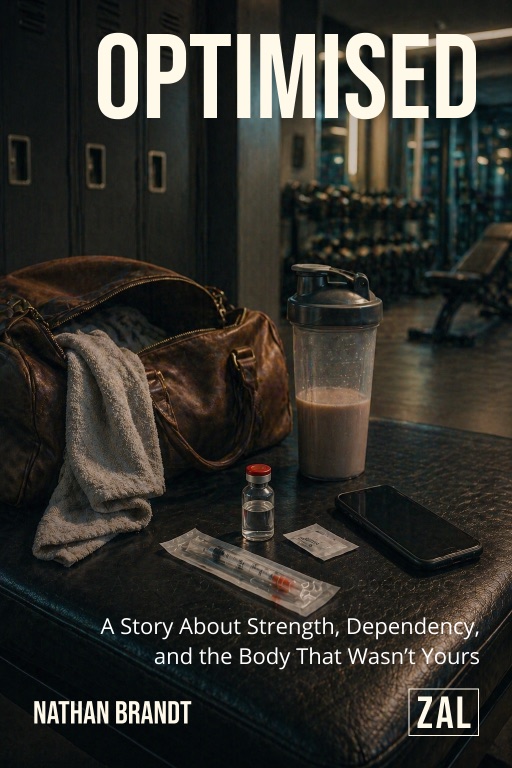
Optimised cover

Lee and Greg's story

The mirror got louder. Nothing you did made it quieter.

Two men. Two substances. The same trap: chasing a version of yourself that starts to require constant maintenance.

$4.99 EPUB + PDF About 3 hours Coming soon

The diagnosis

When better starts requiring maintenance.

Wanting to feel stronger, clearer, leaner, more energetic, or less invisible is not the problem. The problem starts when the body becomes a scoreboard and every improvement immediately creates the need for another upgrade.

Optimised is for the man who is not reckless, stupid, or vain, but has started treating his body like evidence. Evidence that he is still desirable. Still relevant. Still disciplined. Still not falling behind. The book looks at what happens when ordinary health begins to feel too slow, and better starts to come with a cost nobody wanted to price honestly.

Two men

Lee chases the body. Greg chases the version of himself that used to walk into rooms.

Lee Harding is twenty-two, working warehouse shifts in Leeds and training six days a week. He has already changed his body honestly, but the algorithm keeps showing him men who make his progress feel small. Then men at the gym start moving faster than natural progress allows, and his first cycle begins to look less like a line crossed and more like the obvious next tool.

Greg is forty-seven, married to Willa, working in marketing in Houston, and quietly watching younger men take up the kind of room he used to own. A fatigue ad sends him to a telehealth clinic. His testosterone is normal, but low-normal, and the clinic gives him a language that makes optimisation sound responsible. Both men get something real. Neither man gets it for free.

The reframe

The body is not a subscription product.

This is not a book saying testosterone therapy is always wrong, steroid users are idiots, or wanting to feel better in your body is shameful. It is more interested in the question underneath the substance: what are you actually trying to treat?

A deficiency is one thing. Fatigue, comparison, shame, age, fear, loneliness, sexual anxiety, status panic, and the need to be seen are another. Optimised asks what happens when a man buys a stronger version of himself before he has told the truth about why the current version feels unacceptable.

Inside the book

What the story puts under the light.

Algorithmic body pressure

Lee's story follows the gap between real training progress and the enhanced bodies online that keep moving the finish line.
The steroid decision chain

The book shows how a cycle becomes normalised through gym culture, research, private forums, and the sentence men use to reassure themselves: it is just a tool.

Telehealth optimisation

Greg's story looks at the grey area between treatment and performance: low-normal numbers, subscription clinics, upsells, and the language of becoming fully optimised.

Hidden costs

Acne, mood, fertility, blood markers, HPG axis suppression, secrecy, relationship strain, and the way private decisions can quietly recruit other people into their consequences.

Maintenance over performance

The way back is not humiliation or purity. It is proper medical care, honest relationships, sustainable training, and learning to inhabit a body without making it pass an exam every morning.

Read a page

From Before/After.

Lee Harding was twenty-two years old and he was looking at a man who didn't exist.

The algorithm had learned him over two years of daily use and now it delivered exactly what it knew he wanted, which was also the thing that made him feel worst about himself.

But the algorithm didn't show him the man he was at twenty. It showed him the man he wasn't yet.

Where it fits

Start here if your body has become a scoreboard.

Optimised stands on its own as Lee and Greg's story. It is also the companion book that goes deepest into the guidebook's material on body pressure, health, shame, ageing, maintenance, and the cost of turning self-care into proof.

If The Quiet Weight gives you the full map, Optimised stays with the body: the mirror, the clinic, the gym, the bloodwork, the private lie, the partner who deserved the truth, and the slower return to a body that does not have to be constantly upgraded to be worth living in.

What you may recognise

Knowing the body online is not natural and comparing yourself to it anyway.

The ad that found you at exactly the right tired, fading, slightly frightened moment.

The creeping suspicion that the version of yourself you are chasing might require permanent maintenance to keep.

Coming soon

Optimised

This one isn't out yet. Leave your email and you'll hear the day it is.

One email when Optimised is released. Nothing else.

Related essays

Start with the problem, then come here.

Body image, health, steroids, TRT

I Work Out but Still Hate My Body

The goal was to feel better. Instead, the pursuit became the problem. Reclaiming yourself means deciding what your body is for.

Read article Routes to Optimised

Questions

Before you buy.

Is this book anti-TRT or anti-steroids?

No. It is not a blanket condemnation. It is a story about context, motive, secrecy, consequences, and the difference between appropriate medical treatment and chasing an optimised self because ordinary life has started to feel unacceptable.

Is it medical advice?

No. Optimised is fiction with practical emotional insight. It is not a substitute for a qualified clinician, proper bloodwork, or medical supervision.

Is this only for gym men?

No. Lee's route runs through gym culture and anabolic steroids. Greg's route runs through age, fatigue, work pressure, telehealth TRT, and fear of fading. The shared pressure is broader than the gym.

What formats are included?

Optimised includes EPUB and PDF downloads. It is also included in the complete bundle.

This is Chapter One of Optimised.

Chapter 1: Before/After

Lee Harding was twenty-two years old and he was looking at a man who didn’t exist.

The man had traps that rose from his shoulders like geography. His chest had a separation down the middle that caught shadow. His arms, even relaxed, suggested something deliberate and complete. In the caption he said he’d been training for three years and eating clean. In the comments, someone asked about his programme and he’d posted a PDF for £29.99.

Lee scrolled past him. The next one was similar. Then the next.

It was half eleven on a Tuesday night and he’d been on his phone since he got home from the warehouse at nine, still in his work clothes, sitting on the edge of his bed in his flat in Beeston. The flat was a one-bedroom on a terrace that backed onto a car park. At this hour the street noise had mostly settled to a low hum - the occasional bus on the main road, someone’s television through the wall, a dog barking in the distance. His work clothes smelled of the warehouse: forklift diesel, cardboard dust, the synthetic warmth of a heated building. He should have showered. He scrolled instead.

The algorithm had learned him over two years of daily use and now it delivered exactly what it knew he wanted, which was also the thing that made him feel worst about himself. He understood the mechanics of it. He’d read the articles. He scrolled anyway.

He stopped on a before/after. Two photos side by side - same man, eighteen months apart. On the left he was soft, self-conscious, arms slightly away from his body in the way people stand when they don’t want to take up space. On the right he was different in a way that went beyond the muscle. He was standing differently. Looking at the camera like he’d decided something.

Consistency is the only secret, the caption said. No shortcuts. Just showing up every day.

Lee read it twice. Then he went to the man’s profile and scrolled back eighteen months to find the beginning.


He’d been training for two years himself. Started at twenty when a girl he’d been seeing for eight months told him she’d been seeing someone else for three of them, and he needed something to do with the evenings that wasn’t sitting in his flat thinking about it. His mate Jordan knew someone who worked the desk at a gym on Dewsbury Road, got him a cheap membership, and Lee had shown up three times a week for the first month purely out of stubbornness.

The first session Jordan had come with him. This was in February, a grey Tuesday, and the gym had the low-ceilinged, slightly damp quality of every gym in a converted industrial unit - rubber floor, strip lighting, the clang of free weights echoing off bare walls. Jordan had stood at the edge of the squat rack with his arms folded, watching Lee attempt to work out where to start.

“Bar’s twenty kilos,” Jordan said. “Start with just the bar.”

“I know that.”

“You looked like you didn’t know that.”

Lee had loaded on a couple of tens anyway and tried to squat it and got about halfway down before something in his hips said no and he had to stand back up. Jordan had not been diplomatic about this.

“Give over,” Jordan said, taking the tens off. “Technique first. You’re not impressing anyone.”

He wasn’t. There was nobody to impress. The gym at seven PM was mostly older men who’d been coming for years and paid no attention to anything except what was directly in front of them. Lee had squatted an empty bar for twenty minutes while Jordan timed his rests and told him to keep his chest up, and he’d driven home aching in muscles he hadn’t known were there, and he’d come back on Thursday.

Then something shifted.

He was good at it. Not naturally — he’d been the skinny kid at school in Hunslet, the one the PE teacher didn’t bother with, built like a question mark and about as useful in a scrum. But in the gym he found that if he paid attention, if he actually learned what he was doing rather than just picking things up and putting them down, he improved. Consistently. Week after week. He read about programming and progressive overload and nutrition. He tracked his lifts in a notes app. He stopped going out on Friday nights because he trained Saturday mornings and he wanted to mean it.

By the end of year one he’d put on almost a stone of muscle. People at work noticed. His mum said he looked well. A girl on the tram home looked at him in a way she wouldn’t have looked at him before, and he’d spent the rest of the journey trying to work out if he’d imagined it. When he’d deliberately sat across from her the next week and she’d held his gaze for longer than was accidental, he’d known he hadn’t.

He hadn’t imagined it. The body counted as evidence that he was becoming someone different. He hadn’t known he was waiting for that kind of evidence until he got it.

Year two he got more serious. Trained five days. Ate more protein than he’d previously thought was possible. Cooked chicken and rice in industrial quantities. Made mental calculations about macros. Took creatine, which worked, and a dozen other supplements, which mostly didn’t but he bought anyway because the guys online swore by them. He watched YouTube for hours—form breakdowns, programme reviews, natural bodybuilders explaining their approach. He got good at spotting the ones who weren’t natural. The proportions that didn’t add up. The conditioning that arrived too fast. The traps and shoulders that grew at a rate two years of lifting can’t actually produce. The way their shape looked different in a way he couldn’t quite name but could feel.

He knew. He’d watched enough to know exactly what he was looking at when he saw it. He told himself he was better than that. More disciplined. More willing to wait. More real.

He was, genuinely, in decent shape. His arms were real. His back was real. He’d earned it. If you put him next to the man he was at twenty he’d look like a different person.

But the algorithm didn’t show him that version. It showed him the man he wasn’t yet.