The problem: You are objectively better than before and still feel behind.
Almost nobody tells you what a realistic natural physique actually looks like, which is the single most useful piece of information available to a man who trains.
The cruel thing about male body pressure is that improvement does not always make the pressure quieter. You can add muscle, lose weight, eat better, train harder, buy better clothes, get compliments, and still feel one step away from acceptable. The mirror moves with you. So does the goalpost.
That is what makes the “never big enough” problem so exhausting. It rarely announces itself as insecurity. It can hide inside discipline, gym consistency, nutrition, research, progress photos, and the private feeling that you are only allowed to relax once the body finally becomes undeniable.
Improvement can become another scoreboard
There is nothing wrong with wanting to be stronger, leaner, healthier, or more comfortable in your body. For a lot of men, physical training is one of the first places they learn evidence, patience, and self-respect. The problem begins when the body stops being something you live through and becomes something you constantly submit for judgment.
Then every reflection becomes data. Every photograph becomes a verdict. A shirt fitting badly can ruin the day. A good workout can feel like proof you are briefly safe. A missed session can feel like a fall from the man you are trying to become.
The feed makes this worse because it does not show ordinary bodies in ordinary light. It shows enhanced bodies, perfect angles, selective dehydration, professional posing, and men whose income depends on making your normal progress feel behind. Even when you know this intellectually, the comparison can still land.
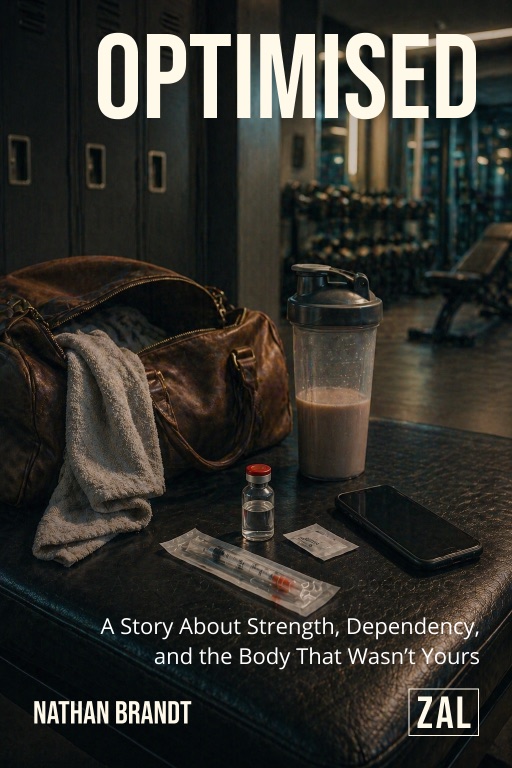
Lee knows many of the bodies are not natural. He compares anyway. That is why Optimised starts in the gap between what a man knows and what the mirror still does to him.
Why the standard was not built for you
It is worth understanding where the male body standard comes from, because it did not evolve naturally or democratically.
The physiques that circulate most aggressively online are a specific product of several converging forces: steroid use that is systematically underreported, professional photography and lighting, digital editing, extreme cutting protocols timed for photographs, and the financial incentive to produce content that makes ordinary men feel inadequate enough to keep watching. The body shown is not the result of hard work alone. It is a production.
This does not mean you cannot improve your body or that training is pointless. It means the thing you are comparing yourself against is not what it appears to be. You are measuring your ordinary self against a manufactured extreme, then interpreting the gap as evidence of personal failure.
Once you see the mechanism clearly, the comparison does not automatically stop. But it loses some of its authority. The gap is not as real as it felt.
The body you live in versus the body you perform
Male body pressure often creates a split between the body as experience and the body as object. The body as experience is the one that tells you when you are hungry, tired, in pain, or physically alive. The body as object is the one you check in mirrors, measure, photograph, and compare.
For men caught in the never-big-enough pattern, the object version starts to dominate. The experience version gets managed and suppressed. Hunger becomes an inconvenience. Tiredness becomes a weakness. Rest becomes lost progress. The body is no longer a place to be; it is a project to complete before you can finally relax.
The problem is that the project never completes. There is always more to add, more to cut, more to improve. The experience of being inside the body — pleasure, rest, ordinary movement, food, recovery — becomes increasingly distant from the work of managing the body’s appearance.
What the body obsession costs elsewhere
The never-big-enough problem does not stay contained to the gym. It tends to leak.
It can affect intimacy — a man so focused on how his body looks that he is not fully present during sex, monitoring himself from the outside when he should be with another person. It can affect food — a complicated relationship with eating that swings between strict control and secret excess, both driven by the same underlying anxiety. It can affect how a man spends time with his family, because the rest day that should be rest is spent feeling behind and guilty.
It can also affect how a man relates to other men. Male body anxiety often converts into a strange mix of competitiveness and contempt. Men who feel insecure about their own bodies can find it difficult to be genuinely warm toward men who seem to have solved the problem. The gym can become a place of silent ranking as much as physical work.
None of this is inevitable. But it is worth seeing the full range of what the pattern costs before deciding that chasing the standard is still worth it.
One thing to try
Before comparing your body to anyone online, compare today’s body to your starting body. Not to flatter yourself. To return to reality.
Ask: what can this body do now that it could not do before? What health signal has improved? Where am I treating a normal human body like a failed product?
The first comparison is data. The second is usually a trap.
Where to go next
This article names the pressure and gives one way to step out of comparison for a moment. Optimised goes deeper into the cost of trying to solve being human through enhancement, optimisation, TRT, bodies, clinics, and the dream of finally feeling enough.
One thing to try
Compare today's body to your starting body before comparing it to anyone online. The first comparison is data. The second is usually a trap.
Where to go next
If this is the room you are in, start with the book that goes deeper into the pattern without turning it into a performance. Start with Optimised.