The problem: You are tired, fading, or worried about age, and optimisation is starting to look like rescue.
Search for TRT before and after and you will get hundreds of results. Nearly all of them are published by clinics, nearly all of them stop at three months, and nearly all of them were written by someone who gets paid if you start.
That is not a conspiracy. It is just what a before-and-after is for. The problem is that the interesting photograph is not month three. It is month eight, and month eighteen, and the month you try to stop.
Testosterone conversations are often too loud to be useful. One side treats TRT as reckless vanity. The other treats it as responsible self-management, like updating an old operating system. Real life is messier than either argument.
Some men have a real medical issue and need proper care. Some men are exhausted, under-slept, underfed, overworked, drinking too much, training badly, lonely, ageing, anxious, and being sold a subscription to a better-feeling version of themselves before anyone has honestly looked at the foundation.
The offer is aimed at a real fear
The optimisation trap works because it does not speak to nothing. It speaks to fatigue, age, low mood, reduced sex drive, body anxiety, work pressure, and the fear that you are becoming less of the man you used to be. That fear can make a clinic ad feel like rescue.
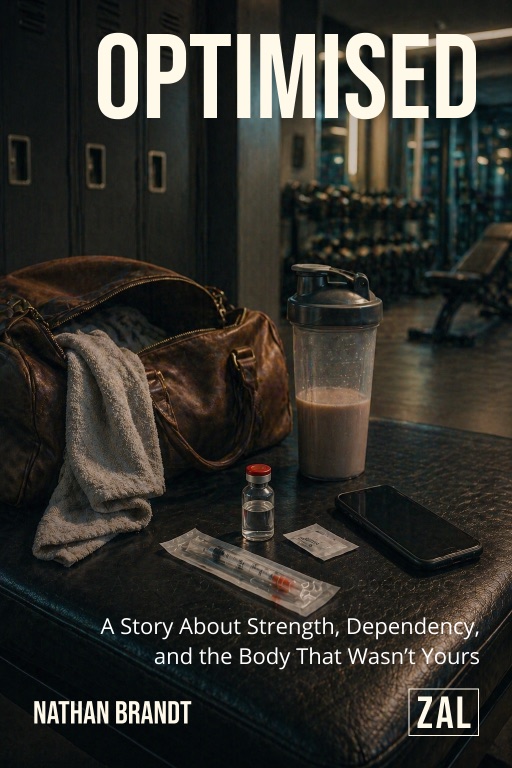
Greg’s story in Optimised begins with fatigue, age, work pressure, and an offer that knows exactly how to speak to those fears. That does not make him foolish. It makes the offer well aimed.
The danger is not that medical treatment is always wrong. The danger is treating a complex human life as if it must have one technical fix. If the body is tired because sleep is broken, alcohol is high, stress is constant, training is chaotic, food is poor, and the relationship is distant, testosterone may become a way to avoid looking at the life that is asking for care.
Why the offer lands when it does
The timing of when men start taking optimisation offers seriously is not random. It tends to cluster around moments of loss or fear: the late thirties, when recovery from training slows and the body feels less forgiving. A period of sustained stress where sleep has been poor for months. The end of a relationship. A new job that carries more pressure. A friend’s diagnosis. A mirror moment.
The offers know this. They are designed to arrive in the vocabulary of those moments. You are not ageing badly, you are declining preventably. You are not tired from overwork, your hormones are off. You are not going through a difficult season, your biology is failing you. The language of dysfunction is much more actionable than the language of ordinary human difficulty.
That is not cynical. For some men, the biology genuinely needs attention. But for many, the offer connects to the fear rather than the cause. And once you are inside the fear, the solution being sold — clear, specific, purchasable — can feel more honest than the messier truth that several things in your life need attention at once.
What the funnel is selling
Testosterone replacement has become a legitimate industry, and like all industries it contains a range of quality. At one end are careful clinicians doing proper work. At the other end are services designed to move men from online ad to monthly subscription with minimum friction and minimum honest questioning.
The subscription model deserves scrutiny. A service that profits from a man continuing treatment has a different incentive than a service designed to help him find the minimum effective intervention and then step back. These are not the same.
Men inside optimisation funnels often report a version of the same arc: initial relief, improved numbers, a period where everything seems to be working, then a gradual recognition that the things they were hoping testosterone would fix — mood, drive, confidence, relationship, energy, purpose — have not changed as much as the numbers. The life still needs work. The work just has a different landscape now.
Ask what you want it to solve
The honest question is: what problem are you treating?
A clinical deficiency is one thing. A fear that ordinary decline means you are disappearing is another. They can overlap, which is why this is not a simple yes-or-no subject. But they should not be confused.
If you are considering TRT, the grown-up move is not panic and not blind optimism. It is proper medical assessment, clear blood work, serious questions about side effects and dependency, and a look at the ordinary basics that may be less exciting but still matter.
One thing to try
Before any clinic funnel, write down seven things:
Sleep.
Alcohol.
Training.
Food.
Stress.
Blood work.
What you hope testosterone will give you emotionally.
That last line matters. More confidence? More desire? More drive? More control? Less fear about ageing? Less shame about the body? None of those hopes are stupid. But if you do not name them, they can quietly run the decision.
Then ask one more question: if this helped my numbers but did not fix my life, what would still need attention?
This is not medical advice. It is a way to slow the story down before urgency sells you a simple answer to a complicated problem.
Slow the decision down
Urgency is one of the signs that the emotional hook is active. If the offer makes you feel as if you are falling behind every day you do not act, slow down. A good medical decision can survive proper questions. A serious clinic should not need you panicked.
Talk to a qualified clinician who is not simply trying to convert you into a customer. Get proper testing. Ask what happens if you stop. Ask what the plan is beyond the first prescription. Ask what ordinary health work still needs doing regardless of the numbers.
The aim is not fear. The aim is adulthood. Your body is not a subscription funnel. It is where you live.
The basics still matter after the prescription
One reason optimisation gets seductive is that it seems to promise an escape from ordinary maintenance. But even if treatment is appropriate, the basics do not disappear. Sleep still matters. Food still matters. Alcohol still matters. Stress still matters. Training still matters. Relationships still matter.
If a man wants testosterone to rescue him from every ordinary demand of being a body, disappointment is likely. Medicine can be part of care. It cannot replace the life that care has to live inside.
Where to go next
This article keeps the frame narrow: ask what you are treating and what you are asking optimisation to carry. Optimised goes further into the emotional cost of turning body, age, medicine, masculinity, and desire into a performance problem.
One thing to try
Before any clinic funnel, write down sleep, alcohol, training, food, stress, blood work, and what you hope testosterone will give you emotionally.
Where to go next
If this is the room you are in, start with the book that goes deeper into the pattern without turning it into a performance. Start with Optimised.