The problem: You do not know what is yours when work, status, usefulness, or attention are removed.
A lot of men build lives like staging a house for sale. Better body, better job, better profile, better systems, better proof. The work is real, but the imagined viewer is always in the room. Even rest can start to feel like something that needs to be justified by future productivity.
The zero-audience life asks a quieter question: what would still count if nobody saw it?
Not what would look impressive. Not what would make a good post. Not what would prove you are disciplined, desirable, high-value, healed, optimised, or ahead. What would actually make the life more inhabitable for the man living it?
The imagined viewer gets expensive
There is nothing wrong with wanting to be respected. Men are social beings. We care how we are seen. The problem begins when the imagined audience becomes the hidden owner of your life.
You train, but mostly to be assessed. You work, but mostly to prove you are not falling behind. You learn, but mostly to fix the feeling that you are not enough. You date, but every result becomes data about your rank. You rest, but only if you can defend it.
This creates a strange kind of homelessness. From the outside, the life may look increasingly impressive. Inside, it can feel like there is nowhere to sit down.
A life has to be lived in
This is not an argument against ambition. It is an argument for living in the house you are building.
Cooking properly counts even if nobody praises it. Moving your body counts even if it does not transform your appearance. Keeping a friendship alive counts even if it is not dramatic. Apologising cleanly counts even if it is not witnessed. Going to bed on time counts. Making the appointment counts. Turning toward your partner instead of disappearing counts.
These actions are not glamorous. That is part of their value. They return care to the actual life instead of the imagined scoreboard.
One thing to try
Do one good thing for yourself this week that nobody will reward, notice, or turn into content.
Make it small enough to actually happen. Cook a meal. Wash the sheets. Walk without tracking it. Send the text. Book the check-up. Put the phone outside the bedroom. Sit with a coffee and do nothing useful for ten minutes.
Then do not convert it into a performance. Do not announce it as a new era. Do not build an identity around it. Let it count quietly.
The question is not whether one small action changes your life. The question is whether you can care for yourself without needing an audience to validate the care.
What happens when the audience is removed
Some men discover the problem most clearly when the performance context disappears. Retirement. Redundancy. A long illness. Lockdown. A move to a new city where nobody knows them yet. The external scaffolding of identity — job, output, visible usefulness, social role — suddenly falls away, and what is left is unclear.
This can arrive as an unexpected crisis. The man who prided himself on not needing much finds that without the performance structure, he does not quite know who he is or what he enjoys. He has been so consistently oriented toward the imagined viewer that the private self, the one that exists without applause, has not been given much to live on.
This is not a failure of character. It is a predictable result of spending years inside systems — work cultures, social media, certain types of masculinity — that relentlessly reward production and visibility. The private self can atrophy the same way a muscle atrophies when it is not used.
The rebuilding is ordinary rather than dramatic. Not self-discovery on a mountain. More like: noticing what you actually enjoy when nothing is on the line. Cooking for the pleasure of the food rather than the compliment. Moving because the body wants to rather than because the data is being collected. Spending time with people without calculating the social return.
The private life is the real test
The private life is where the truth usually shows first. How you eat when nobody is coming over. How you speak to yourself after a mistake. Whether you answer the message. Whether you keep the promise that has no witness. Whether you repair after being sharp. Whether you can rest without making rest useful.
None of that is glamorous, but it is the material of a life. A man can look impressive in public while quietly abandoning himself in private. He can also look ordinary from the outside while building something strong, decent, and real where nobody is applauding.
The zero-audience life is not smaller because it is private. It is stronger because it does not need constant permission from the crowd.
This is not withdrawal from the world
A zero-audience life does not mean hiding, shrinking, or pretending other people do not matter. It is not a rejection of love, work, ambition, sex, friendship, money, or public contribution. It is a correction of ownership.
Other people can be part of the life without becoming the audience the whole life is staged for. You can build something visible and still have a private centre. You can want respect and still refuse to let respect become the only proof that you exist.
The question is whether your life has any rooms where care happens without performance. If it does not, start there.
Where to go next
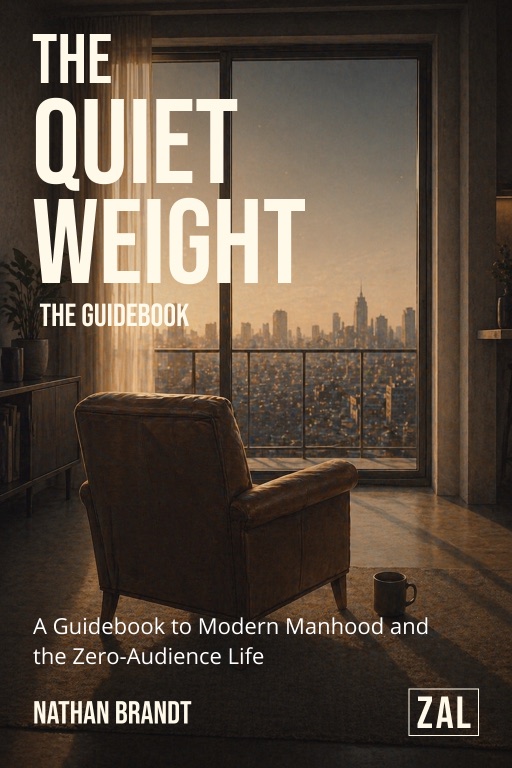
This article is the doorway. The flagship guidebook is the full map: loneliness, burnout, self-improvement traps, body pressure, mental health, numbing, anger, shame, intimacy, relationships, identity, and long-term change. The Zero-Audience Life is not about transformation as spectacle. It is about return.
One thing to try
Do one good thing for yourself that nobody will reward, notice, or turn into content.
Where to go next
If this is the room you are in, start with the book that goes deeper into the pattern without turning it into a performance. Start with The Quiet Weight.