
The system diagnostic
Mason starts tracking the real inputs: sleep, workload, interruptions, food, recovery, relationship debt, and the places where he keeps calling collapse a busy week.
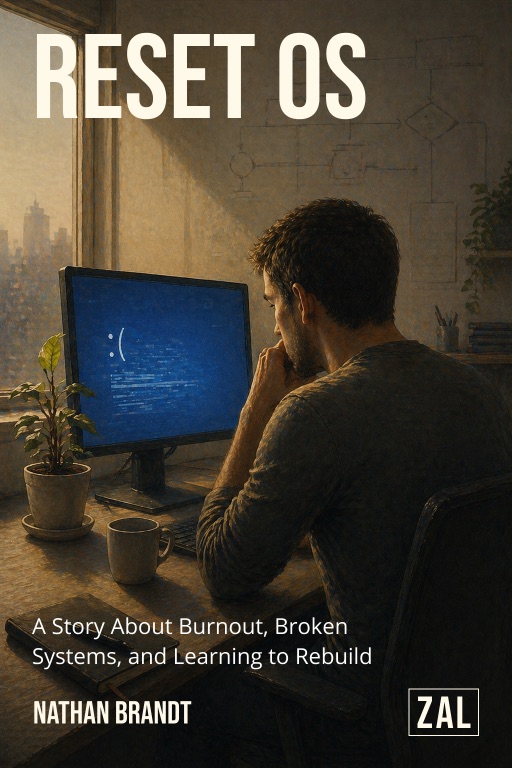
Mason's story
A software developer tries to solve burnout with systems thinking, then realises the thing breaking is not the product.
The diagnosis
Most men do not call it burnout when it starts. They call it a busy quarter, a rough patch, a push, a sprint, a temporary load. You tell yourself that if you can just manage your time better, wake up earlier, silence a few notifications, or find the right productivity app, the system will hold.
But some loads stop being temporary. They become the weather. You are still delivering, still replying, still showing up to the call, still keeping the thing online, but the maintenance window has disappeared. Reset OS is for the man who is technically functioning while quietly knowing the system is no longer built for the pressure it is carrying.
Meet Mason
Mason Hartley is twenty-eight, works remotely, and used to be good at the job in a way that felt clean. Now he is staring at work he finished two days ago and cannot explain why he did it that way. There are fourteen unread messages. His coffee went cold hours ago. The apartment has started to look less like a home and more like a system failure with furniture.
There is unopened mail on the counter, laundry on the chair, a monitor propped up on three books since January, and a pothos plant from Indigo still somehow alive on the windowsill. Mason is not lazy. He is not stupid. He is not out of ambition. He is a capable man whose environment, sleep, work boundaries, relationship, and nervous system have all been pushed into the same overloaded process.
The reframe
The usual answer to burnout is more discipline. More control. A better calendar. A sharper morning routine. A cleaner stack of habits. Reset OS argues for a different diagnosis: you cannot productivity-hack a life that is structurally over capacity.
Mason has to stop treating himself like faulty hardware and start looking at the architecture: load, boundaries, sleep, context switching, environment, relationship debt, recovery, and graceful degradation. The work is not glamorous. It is closer to maintenance than transformation. But maintenance is what keeps a life from becoming an emergency.
Inside the book
Mason starts tracking the real inputs: sleep, workload, interruptions, food, recovery, relationship debt, and the places where he keeps calling collapse a busy week.
The book shows how responsibilities pile up when competence becomes identity, and how to separate what is yours, what is shared, and what you are carrying to avoid disappointing people.
Mason has to rebuild the missing commute, separate work from recovery, and stop letting every room in his flat issue the same instruction: keep working.
Sleep minimums, food, movement, shutdown rituals, and offline space become part of the operating system rather than treats he earns after the work is done.
Instead of pretending pressure will vanish, Mason learns crisis-mode protocols, minimum viable care, post-mortems, and ways to recover before a bad week becomes a broken life.
Read a page
He'd written this forty-eight hours ago, but it felt like he was looking at someone else's work. The function names were familiar, the patterns were his, but the reasoning behind them was gone. Like trying to remember a dream after waking up.
Two people in the same apartment, technically together, functionally alone. Each small compromise had seemed reasonable on its own. Together, they had become the relationship.
What if this isn't a feature problem? What if this is an architecture problem?
Where it fits
Reset OS stands on its own as Mason's story, but it also deepens the guidebook's chapter on load, work, responsibility, and the cost of being useful past the point of repair.
If The Quiet Weight gives you the full map, Reset OS follows one man through the burnout corridor in detail: the wrong fixes, the missed signals, the damage at home, and the slow work of rebuilding a system that can carry real life.
Finishing work and sitting in the car because walking into the house means another system starts asking for you.
Answering your partner with the voice you normally save for difficult clients.
The productivity app you downloaded to fix the problem that is not a productivity problem.
Coming soon
This one isn't out yet. Leave your email and you'll hear the day it is.
One email when Reset OS is released. Nothing else.
Related essays
Companion route
Reset OS follows a remote developer who realises he cannot out-code a life that has become structurally overloaded.
Companion route
The same small compromises that ruin a codebase can also ruin a life when nobody stops to refactor.
Burnout, work, and responsibility
Hating your job is real information. It is not always a job problem, and swapping employers may not touch it.
Questions
No. Mason is a developer, so the language of the book uses systems, architecture, debugging, and maintenance. The pressure underneath it applies to anyone whose work has expanded past the life supporting it.
It is a character-led story with practical system updates throughout. You follow Mason's life, but the book keeps handing you ways to look at your own load, boundaries, recovery, and routines.
No. Reset OS stands alone. The guidebook is the wider map if you want to connect burnout to loneliness, numbing, shame, relationships, identity, and long-term change.
Reset OS includes EPUB and PDF downloads. It is also included in the complete bundle.