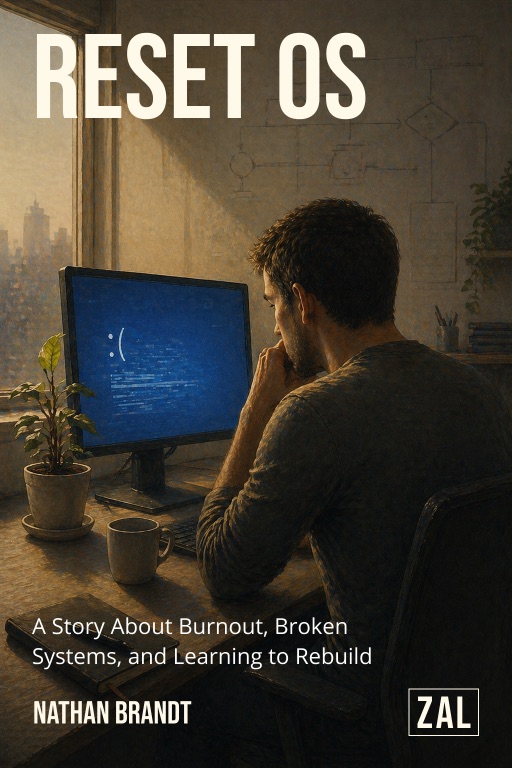
The problem: You are a technical person trying to debug exhaustion with the same brain that exhaustion has already worn down.
Most software burnout stories get pulled toward the wrong kind of drama. Founder nearly dies building a company. Genius coder loses himself to the mission. Startup martyr discovers sleep after the exit. Reset OS is not that book.
Mason is a software developer employee. Remote. Capable. Not famous. Not trying to build an empire. He is not a founder, not a thought leader, not a man turning exhaustion into a brand. He is the kind of developer who used to enjoy the clean feeling of solving a problem and watching the pieces fit.
Mason is not a founder myth
Now simple work takes too long. Slack feels like weather. His apartment has become a blended space for coding, eating, scrolling, avoiding, and failing to recover. The work still matters to him, but it no longer gives back what it takes.
The story begins with a moment many technical workers will recognise: staring at your own work and not being able to explain how you got there. The code functions, but the person who wrote it is not functioning cleanly anymore. That is a different kind of fear. Not just imposter syndrome. Not just tiredness. The private knowledge that your own mind is no longer returning the performance you expect from it.
That is the central reframe of Reset OS. Mason does not have a feature problem. He has an architecture problem.
Feature problem or architecture problem
A feature problem says: fix this one thing. Get a better task manager. Block your calendar. Buy the ergonomic chair. Turn off notifications. Sleep more. Those things may help, but they do not touch the foundation if the life is built for constant throughput with no maintenance window.
An architecture problem says: the system is behaving according to how it was built. If work can enter every room, it will. If every message is treated as urgent, urgency becomes the climate. If recovery is optional, recovery disappears. If the relationship only gets whatever attention is left after work takes its share, the relationship becomes technical debt.
Reset OS uses systems language because that is how Mason understands the world. Context switching. Monitoring. Error handling. Technical debt. Resource exhaustion. But the story is not a gimmick. It is about a man slowly admitting that the broken system includes sleep, food, work boundaries, his body, his relationship with Indigo, and the version of himself that keeps promising to catch up later.
The surface-level tool is the architecture question. Pick one broken area of your life and ask: am I trying to fix a feature, or is the whole system producing this result? If you keep missing meals, is the problem discipline, or a workday with no protected lunch? If you keep snapping at your partner, is the problem attitude, or a nervous system arriving home with nothing left? If sleep keeps losing, what keeps being allowed to beat it?
The architecture question
Do not answer everything. Pick one area. Name the architecture underneath it. That is enough for an article.
For example: if you keep working late, the feature-level answer is better time management. The architecture-level question is why your day allows urgent messages to enter every hour without a gate. If you keep eating badly, the feature-level answer is more willpower. The architecture-level question is why the only available food at 8:45pm requires delivery. If you keep losing evenings to screens, the feature-level answer is deleting apps. The architecture-level question is what feeling arrives when the noise stops.
Mason’s story is specific to software, but the emotional shape is broader than tech. He is a man who keeps mistaking survival tactics for a life. He keeps assuming the next sprint, next fix, next boundary, or next burst of discipline will give him back to himself. The book is about what happens when he finally stops treating himself as an unreliable machine and starts treating the life as something designed.
Where the story goes deeper
That is the difference between a tip and a story. A tip can help tomorrow. A story can show the pattern long enough for you to recognise your own version of it.
If you want the full story of a man taking that question seriously, Reset OS is the route. The Quiet Weight gives the wider map for men who recognise the same pattern beyond work: load, numbing, identity, relationships, and the long repair of a life that has been over capacity too long.
One thing to try
Ask one architecture question: am I trying to fix one broken feature, or am I running a life built for constant sprints?
Where to go next
Reset OS is the deeper story for readers who recognise burnout through code, systems, and remote work. Start with Reset OS. If you want the connected story route, also look at The Quiet Weight.