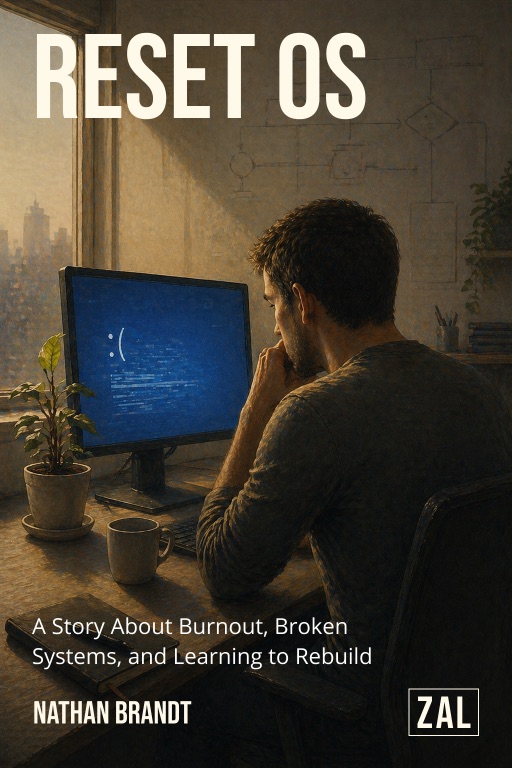
The problem: You keep trying to fix the broken system, but the system is broken because of how it was built. You cannot patch your way out.
“I hate my job” is a sentence worth taking seriously, and also worth interrogating, because a surprising number of men who say it do not have a job problem. They have a capacity problem that the job happens to be sitting on top of.
The trap of burnout is that it arrives wearing the language of failure. You are not disciplined enough. You are not managing time well enough. You are not optimizing the right systems. If you just tried harder, were smarter, or found the right tool, things would get better.
This language is seductive because it implies that the problem is solvable. It is a feature problem, not an architecture problem. That means it is your fault, which sounds bad, but it also means you can fix it. You can try harder. You can use the tool. You can optimize.
But sometimes the system is not broken because you are not trying hard enough. It is broken because of how it was built. And no amount of optimization changes how it was built.
The optimization treadmill
Mason in Reset OS spends most of the book discovering this. He tries harder. He optimizes further. He finds new productivity tools. He moves his furniture. He changes when he works. He tracks his metrics. He reads about sleep hygiene. He implements a morning routine. He adds exercise. He tries cold showers and caffeine timing and standing desks. And the system keeps failing him because the system is built for constant throughput with no maintenance window.
Every tool he uses works for a week. Every system he implements helps briefly. And then he is back to the same exhausted place, but now with the additional weight of knowing that he tried and it did not work. That the tool failed. That he is not disciplining hard enough to make the tool work.
The breakthrough does not come from finding the right tool. It comes from admitting that there is no tool that can fix what is structurally wrong.
The difference between feature and architecture
This is where the metaphor of a reset becomes useful. Your computer does not need better settings when it is broken. It needs a reset. Your life does not need better time management. It needs a reset: a moment where you stop pretending the old system can be fixed and admit that it was built wrong from the beginning.
A feature problem is fixable. Your task manager is not showing you the priorities correctly? Get a better task manager. Your email is taking too much time? Batch it. You keep working late? Set a calendar alarm.
An architecture problem is different. Your email takes too much time because you get 200 emails a day and every one feels urgent. Your task manager does not help because there are genuinely more tasks than hours available. You keep working late because the work is designed for constant throughput and there is no natural endpoint.
You cannot fix an architecture problem with a feature tool. You have to change the architecture. And that is terrifying because it means admitting that the life you have built is unsustainable. Not because you are weak. But because it was never designed to be sustained.
The hard admission
That admission is hard because it feels like failure. If the system was built wrong, that means you built it wrong. If it needs a reset, that means you have been running the wrong architecture for years. It means the sacrifices you made—the time you spent away from your partner, the sleep you missed, the friends you stopped calling—it means you made those sacrifices for nothing. Or worse, for something that was always going to fail.
Men often stay in the broken system longer because the admission feels worse than the exhaustion. At least if you keep trying, you can tell yourself that it is temporary. That next quarter will be better. That once you fix this thing, it will all make sense. But if you admit the system is broken, then you have to acknowledge that the next quarter will probably be worse. That there is no fix. That the thing you have been sacrificing for is not worth the sacrifice.
But here’s what comes after admission
But here is what comes after admission: the possibility of choice. As long as you are still trying to fix the broken system, you cannot choose a different one. You are locked in the optimization treadmill. The moment you admit the system is broken, you can start asking what you actually want instead.
This is different from trying harder at the same system. This is stepping off the treadmill. This is saying: I am not going to find a better time management tool. I am not going to add another optimization. I am going to ask: what would a life look like where I am not constantly overloaded?
And that question is dangerous. Because it forces you to examine the system you built. Why does your work require constant throughput? Is that actually necessary, or is that what you were told? Why does your partner accept that you work until you are empty? Is that what they want, or what they have resigned themselves to? Why do you take every task that comes to you? Is that generosity, or is that proving that you are valuable?
What actually stops the bleeding
The practical move is to stop adding and start subtracting. This is not about finding new habits. It is about stopping the things that are making it worse.
For most men running on fumes, that means stopping the constant checking. Stopping the work that never ends. Stopping the belief that one more sprint will fix the exhaustion. Stopping the pretence that rest is negotiable. Stopping the assumption that you are the only person who can do this.
That does not solve the burnout. But it stops the acceleration. It gives you enough stability to notice that the system was never sustainable.
What comes next
Then, from that place of admission, from that ground where you have stopped running, real change becomes possible. Not optimization. Reset. Not a better version of the broken system. A different system altogether.
Reset OS is not a self-help story about finding the right productivity hack. It is a story about a man finally allowing himself to want different things. Not better metrics. Not a faster recovery. Not another optimization. Just a life built for living, not for constant output.
That change only becomes possible after the admission. I cannot fix this. The system was wrong. I need to reset.
The Quiet Weight gives the wider map for that reset: what comes after you stop trying to out-code your exhaustion. But Reset OS shows the specific story of someone realizing that the problem was never the effort. The problem was the architecture. And once you see that, everything changes.
One thing to try
Ask not what to change, but what to stop. Name one thing you are doing that is making things worse, not better. Stop doing that.
A sentence you can use
This is not working. I'm not going to try harder. I'm going to admit that something fundamental needs to change.
Where to go next
If this is the room you are in, start with the book that goes deeper into the pattern without turning it into a performance. Start with Reset OS. If you want the connected story route, also look at The Quiet Weight.