The problem: You keep buying tools for a feeling they never quite deliver.
Self-improvement can make you feel worse in a way that is hard to admit, because the outside behaviour looks responsible. You are reading, tracking, training, planning, optimising, learning, saving, building, and trying to become less stuck. Those are not bad things. Some of them may be exactly what you need.
The problem begins when improvement becomes another way to stay on trial. You are no longer building a life you can live in. You are constantly gathering evidence for the imagined audience: better body, better routine, better money, better profile, better morning, better mind.
Why the self-improvement industry needs you to stay stuck
Not all self-improvement content is designed to help you. Some of it is designed to keep you engaged. There is a difference.
A product that genuinely solves the problem loses a customer. A product that gives partial relief, reactivates the need, and implies there is a next level to reach — that keeps the customer paying. The most successful self-improvement businesses are not built on transformation. They are built on permanent aspiration.
This is not a conspiracy. It is just incentive structure. A fitness influencer who shows you a sustainable twelve-week programme and then says “that’s it, you’re done” cannot grow an audience. The influencer who keeps raising the standard, introducing new metrics, expanding the definition of optimal — that person has a durable business.
Once you see the mechanism, you can start asking which products are actually moving the needle and which ones are primarily good at making you feel like you need to buy something.
The gap becomes the product
Self-improvement becomes harmful when it keeps the wound open. The promise is that the next system will finally close the gap. The business model often depends on the gap staying visible.
That is why some advice gives relief and then quietly reactivates the same inadequacy that sent you there. You feel seen for ten minutes. Then you are reminded that you are still behind, still low-value, still undisciplined, still not fully fixed, still one level away from becoming the man who can finally relax.
A useful tool makes itself less necessary over time. A bad funnel needs you to remain almost fixed but never actually free.
This distinction matters because wanting to improve is not the problem. Men are allowed to want stronger bodies, better work, steadier money, cleaner homes, better sex, more confidence, and more discipline. The problem is being sold a life you never get to inhabit because you are always preparing to become worthy of it.
Improvement can become performance
A lot of men build lives like staging a house for sale. Everything is arranged for the viewer. The body, the books, the habits, the watch, the profile, the productivity system, the way the life photographs from the outside.
But who lives there?
If the answer is “I will live there once I am better,” the work has become a trap. You keep renovating for a future man while the current man eats badly, sleeps badly, avoids his friends, and cannot sit still without a video, a plan, or a scoreboard.
The irony is that this kind of improvement can make a man less attractive and less present, not more. The men who seem most at ease in their lives are generally not the ones performing optimisation publicly. They are the ones who have found something that is actually enough — not as a ceiling, but as a foundation.
The comparison engine
Social media makes this worse because it turns improvement into a ranking in real time. You look at what other men have built, earned, lifted, or achieved, and the gap between your life and their highlight reel starts to feel like evidence of failure.
That gap is not real. You are comparing your interior experience — with all its doubt, tiredness, and private disorder — to someone else’s curated exterior. Nobody shows the version of themselves that is confused, behind, and unsure. So the feed fills up with evidence that everyone else has solved the thing you are still working on.
Closing the app and doing the ordinary thing — sleep, food, movement, honest conversation, a kept promise — is often worth more than another hour of strategy.
One thing to try
Before paying for another product, course, app, community, or system, ask:
Does this person’s business model require me to stay broken?
Then ask the boring test:
Does this advice return me to sleep, movement, honest conversation, real responsibility, friendship, repair, and a quieter life?
Or does it send me toward urgency, paid access, status anxiety, contempt, secrecy, and the next hidden answer?
If the tool helps you do the ordinary thing more consistently, it may be useful. If it mainly makes you feel behind while promising relief later, step back.
Choose one improvement this week that is not visible online and not impressive in conversation. Cook a proper meal. Make the appointment. Send the text. Clean the room. Go to bed. Apologise. Walk. Let care count even when nobody sees it.
Improvement should return you to life
The simplest test is whether the work gives you more life or less. More patience. More honesty. More sleep. More capacity to be with people. More ability to keep promises quietly. More room to enjoy what you already have while still building what comes next.
If improvement only gives you more monitoring, more contempt, more panic, and more reasons to delay living until the next milestone, it is worth questioning. A system can be useful and still become too central. A goal can be healthy and still become a hiding place.
You do not need to become anti-ambition. You need to stop letting ambition be the only language care is allowed to speak.
Where to go next
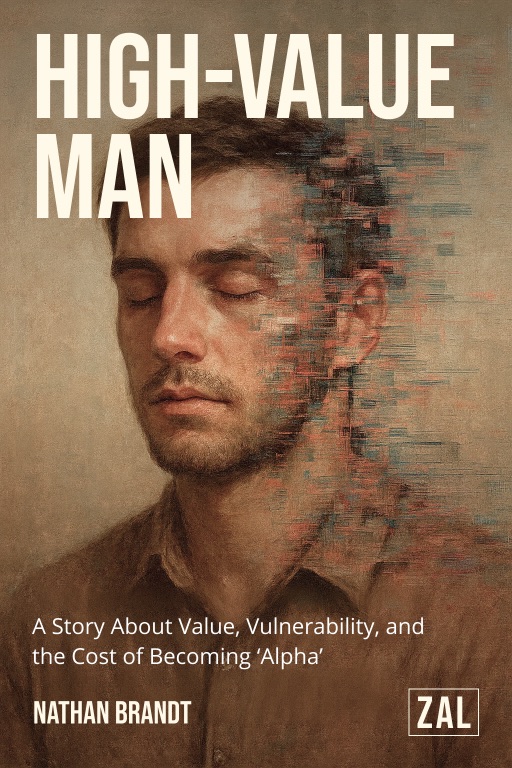
This article gives you a filter for the self-improvement trap. The Quiet Weight gives the wider map for building a life you actually live in. High-Value Man is the story route for men pulled into status, gurus, dating anxiety, and the promise that worth can be engineered from the outside.
One thing to try
Before paying, ask: does this person's business model require me to stay broken?
Where to go next
If this is the room you are in, start with the book that goes deeper into the pattern without turning it into a performance. Start with High-Value Man.