The problem: Everyone thinks you are steady, and you are tired of the cost.
For many men, fine is not a feeling. It is a job. You keep the room steady. You keep the money moving. You make the decision, carry the mood, solve the practical thing, and avoid becoming another problem. If someone asks how you are, the answer comes out before you have checked whether it is true.
“Fine” can be useful. It gets you through work. It keeps panic from spreading. It stops every passing mood from becoming a group project. But when fine becomes automatic, it can start costing more than it protects.
Where the instruction comes from
Men do not invent the pressure to be fine out of nowhere. Most absorbed it early, from enough different directions that it stopped feeling like a lesson and started feeling like a fact about themselves.
Some learned it in families where showing need created trouble. Where someone getting upset meant the whole house tilted. Where the safest thing to do was stay small and steady, because falling apart had a cost. Some learned it from fathers, coaches, or older men who modelled the same stoicism, not as a deliberate teaching, but simply as the only visible template.
Some learned it because they genuinely had to. They were the oldest, the responsible one, the one who stepped up when other people could not. The role was real and the strength was real. But the role can outlast its necessity by decades.
And many men learned it from the culture around them. From sport, from work, from the persistent idea that a man’s value lives in his output and his composure, and that admitting to need is a kind of failure. That instruction gets into the body. After long enough, it does not feel like a choice. It feels like who you are.
Fine can become a role
There is strength in being reliable. Men should not be shamed for wanting to be steady, useful, and dependable. The damage starts when reliability becomes the only gear available. When you are not choosing steadiness anymore, just obeying an instruction you absorbed so early that it feels like your personality.
The result is a man who can carry a lot and ask for very little. From the outside, this can look admirable. Inside, it can become lonely. If nobody knows what something costs you, nobody can meet you there.
This is one of the quieter ways men can become isolated inside apparently full lives. You are present. You are involved. You are managing. But you are managing alone, and the distance between how you are actually doing and what you are willing to say has become large enough that honest conversation feels impossible without a crisis to justify it.
Care cannot only flow outward
The Quiet Weight begins with a practical question: who is responsible for you? Not as complaint. As inventory.
If care only flows outward, something eventually goes unfed. You can be the one who listens, earns, fixes, drives, pays, remembers, absorbs, and still have no clear place where your own weight is allowed to land. That is not strength. That is a system with no return line.
This is why “I’m fine” can become dangerous. Not because every man needs to narrate every feeling. But because automatic fine can block the small signals that prevent collapse. Tired becomes fine. Lonely becomes fine. Angry becomes fine. Numb becomes fine. Not okay becomes fine.
Eventually the people around you are living with the effects of a truth they were never allowed to hear. The distance is felt even when it is not explained. Children notice. Partners notice. And the man himself can feel a growing gap between the life he is maintaining and the person he is becoming inside it.
One thing to try
Name one place where you are performing fine. Do not fix it yet. Just name the room, person, or situation.
Maybe it is work. Maybe it is your marriage. Maybe it is family. Maybe it is the group chat where you only joke. Maybe it is the gym, the pub, the bedroom, or Sunday night when the whole week starts pressing on your chest.
Then try one true sentence, said earlier than usual:
“I’m functioning, but I don’t think I’m actually okay.”
That sentence does not require a full breakdown. It does not make you weak. It does not mean the other person has to fix you. It simply interrupts the automatic script long enough for reality to enter.
Choose the safest person available. If there is no safe person, write the sentence down first. The point is to stop treating silence as proof that everything is under control.
Where to go next
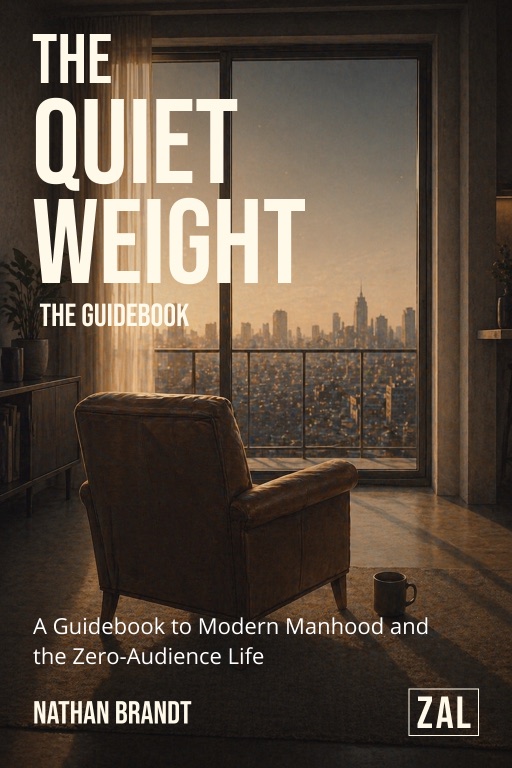
This article gives you the first interruption: one honest sentence. The Quiet Weight goes deeper into the system underneath “fine”: load, loneliness, numbing, shame, intimacy, identity, and the long work of building a life that takes care of the man living it.
One thing to try
Name one place where you are performing fine. Do not fix it yet. Just name the room, person, or situation.
A sentence you can use
I'm functioning, but I don't think I'm actually okay.
Where to go next
If this is the room you are in, start with the book that goes deeper into the pattern without turning it into a performance. Start with The Quiet Weight.