The problem: You stop only when your body or mind makes the decision for you.
You sit down for ten minutes and immediately feel the pull to get back up. Not because anything is on fire. Because sitting still feels like stealing. The washing is there. The email is there. The unanswered message is there. The money thing is there. Someone else is probably doing more than you. Someone else is probably coping better. So you stand up again before your body has even understood that it was allowed to stop.
When stopping feels like stealing
Rest feels irresponsible when you have mistaken depletion for proof that you care. A lot of men do this without noticing. The heavier the load gets, the more morally suspicious rest begins to feel.
You may not say it out loud, but the rule is there: if I stop, I am letting someone down. If I sleep, I am falling behind. If I take an evening, I am making the load heavier for somebody else. If I admit I am tired, I am asking to be handled.
There is a decent impulse underneath that. You do not want to be selfish. You do not want to disappear from people who need you. You do not want to become one more problem in a house, team, or family already carrying enough.
But a decent impulse can still become a damaging rule. Exhaustion changes your character before it changes your calendar. You become shorter, colder, more avoidant. You answer reasonable questions like accusations. You start resenting people for needing things they were always allowed to need. The people you are trying to protect get the least reachable version of you.
Where the guilt comes from
The guilt is not random. It was learned, usually in environments where productivity was the primary language of worth. Where a man’s value was indexed to what he produced, fixed, earned, or solved. Where rest was a reward to be justified rather than a maintenance requirement.
Some men absorbed this from fathers who worked constantly and seemed to treat any pause as weakness. Some absorbed it from financial pressure — real or inherited — that made stopping feel genuinely dangerous. Some absorbed it from the simple fact that in their household, when they stopped, things stopped. The machine only ran because they kept running it.
The rule made sense in context. The problem is that it often outlasts its context by years. Men in their forties are still obeying a rule about effort and worth that may have been written in their twenties, or borrowed from a parent who lived a different life. The urgency feels real, but the threat it was built around may no longer exist in the same form.
Rest and the man who cannot be needed
There is a specific version of rest guilt that affects men who have organised their identity around being useful. For these men, being unavailable — even temporarily, even to themselves — triggers something deeper than inconvenience. It touches the question of what they are worth when they are not producing anything for anyone.
If usefulness is the price of your place in the room, rest starts to feel like a negotiation with belonging. You stop, and the thought follows immediately: what if they realise they do not need me as much as I thought? What if my value is entirely in the doing and the moment I stop doing it someone sees the gap?
That fear is not usually stated directly. It lives in the restlessness. In the inability to sit with a book without part of the mind scanning for the next task. In the slight anxiety that arrives on evenings where nothing demands anything.
Rest is maintenance
This is the part men often miss: rest is not the opposite of responsibility. Rest is part of responsibility when other people depend on your steadiness, judgment, patience, attention, and ability to tell the truth before resentment starts doing the talking.
A machine that never receives maintenance is not heroic. It is badly managed. A body that only stops when it is forced to stop is not disciplined. It is being run without respect for capacity.
One thing to try
Choose one recovery floor — one piece of maintenance so small it cannot become another performance. One walk without your phone. One meal where you are not also doing something else. One hour with the laptop genuinely closed.
Make it specific and fixed before the tired version of you has to decide whether it is deserved.
Where the book goes deeper
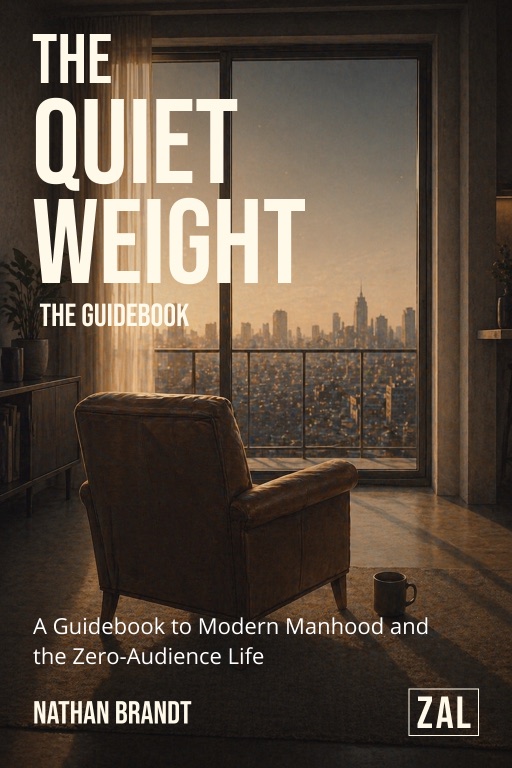
This article gives the first reframe: rest as maintenance rather than desertion. The deeper work is understanding why rest feels dangerous in the first place — what you believe would happen if you became less useful, less available, less easy for a while. That is the architecture the guidebook goes into. The Quiet Weight maps the load, the identity underneath it, and what it takes to build a life that takes the man inside it seriously. Reset OS shows what that reckoning looks like when it can no longer be deferred.
One thing to try
Choose one non-negotiable recovery floor: sleep, food, walk, or one offline hour. Make it too small to argue with.
A sentence you can use
I'm not disappearing. I'm taking an hour so I can come back useful instead of resentful.
Where to go next
The guidebook shows how rest connects to load, identity, shame, and long-term change. Start with The Quiet Weight. If you want the connected story route, also look at Reset OS.