The problem: Everyone depends on you because you are capable, and capability has started to feel like a trap.
There is a particular kind of tiredness that belongs to the man everyone trusts. It is not the tiredness after a hard day where the body knows it has worked and the mind can let go. It is the tiredness of being the backstop. The person who remembers. The person who absorbs. The person who notices the thing that will become a problem if nobody handles it.
When capability becomes the trap
You handle the logistics. You keep the money moving. You stay calm when other people panic. You absorb the awkwardness, the late request, the extra task, the unspoken worry. People trust you because you have earned that trust. Then, quietly, the trust becomes a system that keeps loading you until you cannot tell where responsibility ends and disappearance begins.
This is why being the strong one can feel so confusing. Part of it is real strength. You are not imagining that. There is dignity in showing up, paying attention, fixing what needs fixing, and being someone other people can count on.
The problem is not usefulness. The problem is usefulness becoming the price of belonging.
Useful is not the same as maintained
That shift can happen slowly. Your needs become the movable part. Sleep can move. The doctor’s appointment can move. The friendship can move. The conversation can move. The thing that gives you peace can move. But the deadline, bill, family mood, client emergency, parent worry, or partner’s stress cannot. A man can spend years being low-maintenance and slowly become unmaintained.
From the outside, this can look admirable. He never complains. He just gets on with it. He is easy. But easy is not the same as okay. Easy can mean nobody has had to learn what it costs you because you have made the cost invisible.
The difference between responsibility and self-erasure is simple on paper and hard in real life. Responsibility says: this matters, so I will show up. Self-erasure says: this matters, so I do not.
That difference matters because the person carrying the load is part of the system. If he becomes unavailable to himself, the system has not become stronger. It has become more fragile. The house may still be standing, but one of its main supports is rotting quietly inside the wall.
Why the strong one rarely gets asked
Part of what sustains this pattern is that the strong man tends not to get asked how he is doing. Not because people do not care, but because he has never visibly needed anything. When someone has always answered “fine” and always delivered, the people around him stop testing the answer. They start assuming fine is the baseline rather than the performance.
This is a loneliness that does not look like loneliness. The man is surrounded. People depend on him. The diary is full, the messages keep coming, the role is real. But inside that busy system, there is often no one who knows what it actually costs. No one who has seen him uncertain, struggling, or genuinely in need of something he cannot supply himself.
The invisibility can feel like a trap he has built himself. He trained everyone around him to believe he does not need much. Now changing that requires a kind of honesty that feels disproportionate — because nothing dramatic has happened, no crisis has arrived, and admitting he is depleted means admitting he was not quite as solid as everyone assumed.
The identity underneath
The harder thing to look at is what happens when being the strong one stops being a role and starts being a self-concept. Some men have organised their entire sense of worth around being the one who holds things together. Their value in relationships, at work, in family — all of it is indexed to being reliable, capable, unbothered.
When that identity runs deep, the thought of asking for help or naming a limit does not just feel difficult. It feels like a threat to who they are. Putting the load down — even temporarily, even partially — starts to feel like the same thing as becoming less. Less real. Less worth keeping around.
That is the point where responsibility and self-erasure become genuinely hard to separate. And that is the point where the article runs out of room and the deeper work begins.
One thing to try
Make a private load list. Not a to-do list. A load list. Write down everything you are currently carrying: work tasks, money worries, family admin, emotional monitoring, practical repairs, avoided conversations, things you said yes to because saying no would have taken energy you did not have.
Then mark each item in one of three ways: mine, shared, or not mine.
Do not make changes yet. Do not announce anything. The first win is simply seeing the full list without immediately defending why each item belongs to you.
Where the book goes deeper
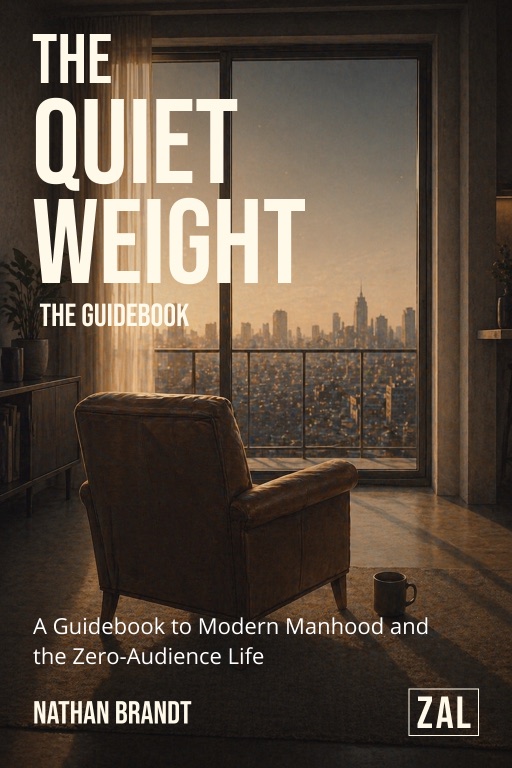
This article can get you to the list. The deeper work is understanding why some loads feel impossible to name, let alone put down, and why usefulness became the thing that earns your right to stay. The Quiet Weight goes into that architecture. Reset OS shows what it costs when the system runs past its limit and the man at the centre finally has to reckon with what he has been carrying alone.
One thing to try
Make a private load list. Mark each item: mine, shared, or not mine. Do not fix it yet. Just stop pretending it is all one category.
A sentence you can use
I've been acting like I've got a handle on all of this myself, and honestly, I don't.
Where to go next
The guidebook goes deeper into the load men carry, how it becomes identity, and how to make it visible without blowing up the life. Start with The Quiet Weight. If you want the connected story route, also look at Reset OS.