The problem: Your workday technically ends, but your body never receives the message.
It is 6:11pm and nothing has changed. Same chair. Same room. Same screen. Your calendar says the day is over, but your body does not believe it. The laptop is still open. The notification light is still there. The mug from this morning is still beside the keyboard. Someone in the house says something ordinary and you answer like they have interrupted a meeting that technically ended forty minutes ago.
When the walls come down
Remote work helped a lot of men. That should be said plainly. Some got time back, saw their kids more, cooked lunch, avoided draining commutes, and became less exhausted. The problem is not remote work itself.
The problem is what happens when the walls come down in the wrong direction.
Work enters the bedroom. The kitchen becomes a meeting room. The laptop becomes a permanent object in the corner of the eye. Slack sits on the same phone as your partner’s message, your mother’s missed call, and the thing you use to numb out at midnight.
The old commute was not always pleasant. It was expensive, crowded, dull, and sometimes grim. But it did one useful thing: it created a physical transition. A train carriage. A walk from the station. A song in the car. Ten minutes where nobody could reasonably ask much from you and the day changed shape before you arrived home.
The day no longer changes shape
When that disappears, the workday does not always get shorter. It spreads. The end of work becomes a tab you leave open. Part of you is at dinner. Part of you is still in the codebase, inbox, spreadsheet, ticket queue, sales deck, or message thread. You are home, but not landed.
This is why willpower is often the wrong first answer. If your laptop stays open on the table, the table is not neutral. If work messages live beside the bed, the bed is not neutral. If every room is a work room, no room is a recovery room.
Men often make this a discipline problem. I should be better at switching off. I should be more present. I should stop checking. Maybe. But the room is giving instructions too. If the environment keeps saying work is available, urgent, and close, your nervous system will keep half-listening.
The surface-level tool is the artificial commute. It sounds almost too basic, which is why it works. At the end of work, close the laptop fully. Put it in a drawer, bag, or another room. Change one visible thing: shoes, shirt, lighting, music, chair. Then leave the house for ten minutes. Walk around the block. No work audio. No calls. No productivity podcast. Just movement that tells the body the day is changing shape.
What the spread costs at home
The unbounded workday does not only affect the man. It affects everyone in the house with him.
The partner who receives the work-emptied version of him at dinner. The children whose requests are fielded with the distracted half-presence of someone still technically in a meeting. The quiet withdrawal that everyone feels but nobody can cleanly name because nothing has obviously gone wrong. He is there. The body is in the room. But the man arrived long before the work actually stopped.
This can create a particular kind of domestic loneliness — a house with people in it where nobody is quite together. The man may not see it clearly because from inside the experience, he feels present. He answered the question. He was there for dinner. He did not shout at anyone. But presence is not just physical proximity. It is the sense that someone is genuinely available in the room.
Remote work has made that availability harder for a lot of men, not through laziness or intention but through the absence of the structure that used to create it automatically. The commute said: now you are home. Without it, home and work have become one continuous context, and the man has never quite arrived anywhere.
Build an artificial commute
When you come back in, enter the room as a person, not as an employee who has moved locations. That distinction may feel artificial for the first few days. Good. It is artificial. So was the missing boundary. You are rebuilding a physical signal your life removed.
If a walk is impossible, create a smaller version. Wash your face. Step onto the balcony. Put the laptop away and make tea. Sit in a different chair. The point is not the ritual itself. The point is giving your body a clean instruction: that part of the day is over.
The second part is protecting one room or surface from work if you can. Not the whole house. One place. The bed is the obvious candidate, but if that is impossible, choose the kitchen table after a certain hour, one chair, or the sofa after dinner. The rule is not moral. It is environmental. A recovery space has to be allowed to mean recovery.
Where the book goes deeper
If you live in a small flat, this matters even more. You may not have more rooms, but you can still create different modes. Laptop open means work. Laptop closed and away means not work. Headphones off means reachable. Shoes on means transition. Small signals sound silly until you have spent months living without any.
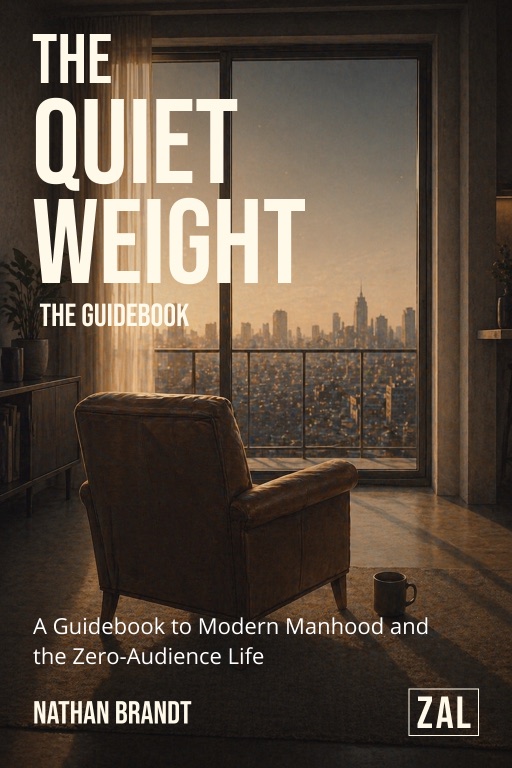
The article can give you the boundary. The books go deeper into why the boundary disappeared, what else the work spread has touched, and how to rebuild the system around a man who needs recovery as much as output. The Quiet Weight gives the map. Reset OS gives the story of Mason discovering this the hard way.
One thing to try
Build an artificial commute: close the laptop, put it away, walk for ten minutes, then re-enter the house as a person rather than a worker.
Where to go next
The guidebook explains how environment, load, numbing, and identity fit together. Start with The Quiet Weight. If you want the connected story route, also look at Reset OS.