The problem: You are treating app results like data about whether you are desirable.
If you have found yourself feeling invisible to women, the apps are usually where that feeling gets its evidence.
Dating apps can make a man feel invisible in a very specific way. Not rejected after being known. Rejected before arriving. Reduced to a photograph, a few lines, a height, a job title, and a sorting mechanism that gives almost no feedback except silence.
That silence can get under the skin. You open the app, swipe, wait, adjust the photos, rewrite the bio, delete a sentence, add a better one, try to look relaxed without looking careless, confident without looking arrogant, interesting without looking like you are trying. Then nothing happens. Or not enough happens. And the mind starts making conclusions.
Why the app is structurally weighted against men
This is not a motivation speech. The numbers are real. On most major dating platforms, the distribution of matches is heavily skewed. A small percentage of male profiles receive the majority of engagement. Most men receive very little. This is documented, consistent, and not a reflection of how desirable those men are in the real world.
The reasons are a mixture of platform design, gender ratio imbalances, the way swiping behaviour differs between men and women, and the fact that photographs and short bios are genuinely poor formats for conveying the things that make a person attractive over time.
Knowing this does not make the silence less unpleasant. But it changes what the silence means. You are not receiving feedback on your worth. You are receiving feedback on your performance in a thin, distorted medium with structural disadvantages built in. Those are different things.
A thin environment creates thick conclusions
Dating apps compress a person into a very narrow signal. If that mechanism leaves you feeling invisible, you are not imagining the experience. It is thin by design.
The mistake is letting a thin environment make thick conclusions about you. Your warmth, humour, steadiness, timing, attention, smell, voice, patience, generosity, and presence barely exist inside the app. In real life, those things are often the whole point.
This does not mean dating apps are fake and real life is pure. Real life can be brutal too. But the app is not a clean measurement of your desirability. It is a small market with its own incentives, distortions, gender ratios, photos, algorithms, timing, and exhaustion.
If you treat it like a referendum, you will start living under a verdict it was never qualified to deliver.
App pain can make bad maps attractive
This is where a lot of men get vulnerable to harsh advice. The app hurts. The silence feels humiliating. The man looks for an explanation, and someone online offers one with confidence: your rank is too low, your value is too low, women only want this, men must become that.
The explanation feels better than confusion because at least it gives the pain a shape. But not every map that explains your pain leads somewhere healthy. Some maps are designed to keep you angry, dependent on the community offering the map, and convinced that the solution is always one more piece of purchased advice away.
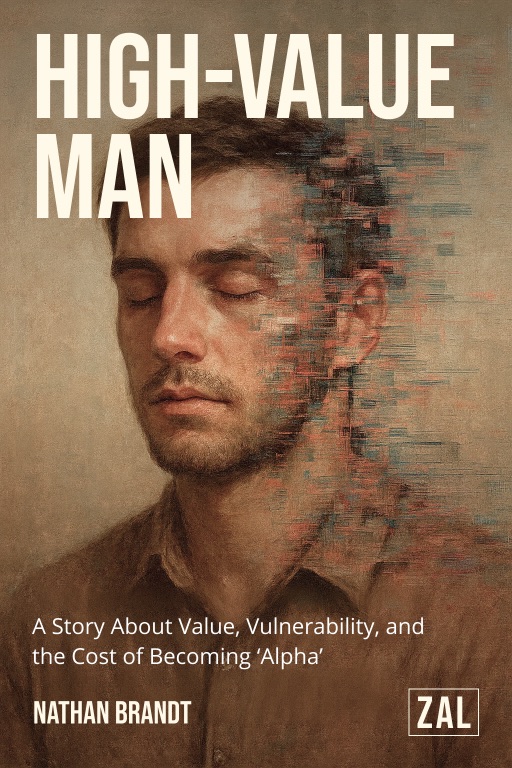
High-Value Man follows Reece as he mistakes app pain for proof that someone else’s hierarchy must be true. That is a common move. A man gets hurt in a distorted environment, then builds an entire identity around surviving that environment instead of widening his life beyond it.
What extended app use does to how you think about yourself
The longer a man spends inside app logic, the more that logic starts reshaping his self-perception. He begins to think of himself as a product with a market position. He adjusts his behaviour not to become more genuinely himself but to perform better in the specific context of being evaluated in two seconds by a stranger.
This is a slow erosion. It is hard to notice from the inside because it feels like self-improvement. But there is a meaningful difference between becoming more confident and interesting in the full context of your life, and becoming better at gaming a photo-sorting algorithm.
The former makes you more present. The latter makes you more anxious.
One thing to try
Use the app as one small-probability channel, not as the court of final appeal.
Set a boundary around it. For example: twenty minutes, three times a week, with no checking afterwards. Then put equal effort into one repeated real-world context. A class, gym time, language group, volunteering, sport, running club, work-adjacent event, bookshop talk — anything where you become a real person through repetition.
The point is not to “meet women” in a forced way. The point is to stop letting one thin channel carry your whole need for connection, confidence, flirtation, risk, and being seen.
If you keep the app, make it smaller. Improve the profile if you want, but do not make profile optimisation the centre of your masculine worth. A better photo can help. It cannot build a wider life for you.
When to actually step back
There is a version of this advice that is sometimes given too quickly: just delete the apps. That is not necessarily the right answer, especially if real-world meeting opportunities are genuinely limited, or if the apps have occasionally produced good results. Deleting the app in frustration and downloading it again three weeks later changes nothing. The underlying dynamic is the same.
The more useful question is whether the app is currently serving you or mostly just measuring you. If you find yourself checking results compulsively, adjusting your profile after every disappointment, or spending significant emotional energy on the gap between what you expected and what you received, the app has become the measuring stick. At that point a limit is more useful than deletion.
Set a time boundary. Specific, non-negotiable, and held to. Twenty minutes on three evenings. Send the messages you want to send. Then close it without checking. Not because the apps are morally bad, but because the way you are currently using them is making things worse.
A phone you pick up twenty times a day for validation is a different object to a phone you use three times a week as one tool among many. The app does not change. The relationship to it changes.
Where to go next
This article gives you one reframe: the app is a channel, not a verdict. High-Value Man goes further into dating anxiety, status, gurus, app pain, and the search for masculine worth in places that keep moving the scoreboard.
One thing to try
Use the app as one small-probability channel, not as a referendum. Put equal effort into one repeated real-world context.
Where to go next
If this is the room you are in, start with the book that goes deeper into the pattern without turning it into a performance. Start with High-Value Man.