The problem: The moment life gets hard, the routines you built to handle hard fall apart. Then everything gets harder.
Stress wants you to cancel the basic systems. It tells you there is no time for the walk because there is too much work. No time for the decent meal because there is too much planning. No time for sleep because there is too much to solve. The appeal is immediate: if you squeeze the recovery, you can fit more problem-solving into the day.
This is the exact moment when the systems matter most. Not when life is calm and everything feels optional anyway. When life is hard and every signal from your body and your mind is telling you to abandon the things that keep you grounded.
The foundation crumbles
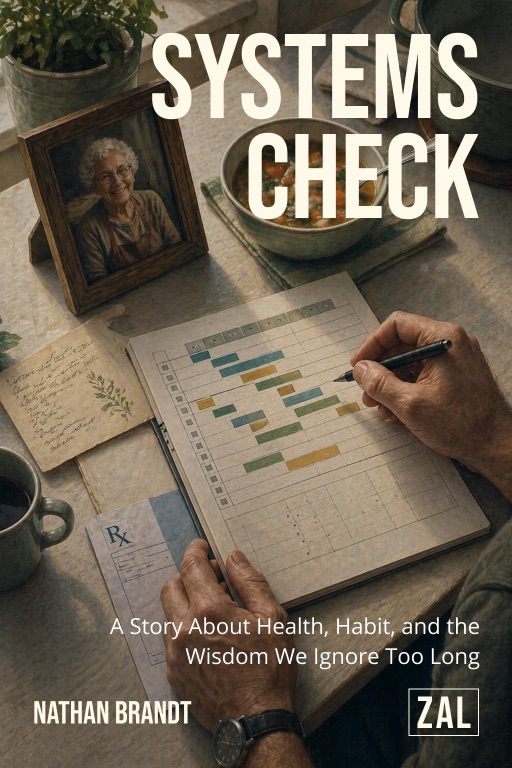
Fin in Systems Check lives this tension. His job is demanding. His attention is fragmented. The pressure to cut corners is constant. And the exact moment he stops taking care of the fundamentals—sleep, food, movement, real human contact—is when the pressure becomes unmanageable.
The trap is believing stress is the exception. It is not. Stress is normal. What matters is which systems stay when normal breaks.
Most men can build a routine when life is calm. The test is whether the routine survives when life is not calm. The goal is not a perfect routine that collapses the moment real pressure arrives. The goal is a minimal routine that can survive pressure.
That is harder than it sounds. Everything in your body will want to skip the walk because of the deadline. The deadline feels more urgent than the walk. But the walk is what makes the deadline manageable. Without it, the deadline becomes unbearable.
The math of stress and systems
Here is what actually happens. Under stress, your nervous system is already flooded. Your cortisol is elevated. Your sleep is worse. Your decision-making capacity is reduced. Your patience is thin. Everything takes more energy.
And then you think: I should skip the routine. I should work longer. I should skip the meal and grab something quick. I should not waste time on the walk. Every minute counts.
This is backwards. Every minute counts for this exact reason: because you do not have any spare capacity. The routine is not padding. It is foundation. When you remove the foundation, the walls crack.
What happens next is predictable. You skip the walk. You stay up later trying to solve the problem. You eat worse food because it is faster. Your sleep gets worse because your nervous system is still activated. You wake up more tired. Your decision-making gets worse. The problem that felt urgent yesterday suddenly feels unsolvable today. So you work longer. Skip more routines. Sleep even worse.
By the time you realize what is happening, you have built a system that is accelerating toward collapse.
Choose three things to protect
The practical move is backwards from what feels intuitive. When stress increases, do not add new systems. Do not suddenly start meditating or journaling or meal-prepping elaborately. Subtract instead. Choose three non-negotiable basics that stay when everything else breaks.
For most men, those three are sleep, food, and movement. Not optimised sleep. Not special food. Not intense training. Just enough sleep that you are not operating on fumes. Just one meal you actually cook and taste instead of ordering. Just one walk or one session of something that moves the body.
The rule is not that these three have to be perfect. The rule is that they do not get cancelled. They are protected space, not negotiable options.
Sleep first, always
Sleep goes first for most men, and that is backwards. Sleep is where the stress processing happens. Sleep is where your brain files away the things from the day and prepares for tomorrow. The moment you need sleep most is the moment you stop getting it, and the stress compounds.
Protect sleep first. Even when everything is on fire, even when the deadline feels more important than rest, sleep stays. This might mean you have less time for work. That is the point. You have less work capacity when you have no sleep. So working less while sleeping more often gets you further than working more while sleeping less.
Food follows. Not because eating is complicated. Because under stress, men often skip meals or eat only what arrives through an app. The nutrition is secondary to what the eating signals to your nervous system. When you take time to cook something, even if it is just pasta, you are telling your body: things are still organized. The basics are still being maintained. This is not emergency mode.
Movement stays because under stress, your body is flooded with the nervous energy that needs somewhere to go. A walk is not because you will burn calories. It is because moving your body gives the stress an outlet. It gives your nervous system something to do other than generate more cortisol. Twenty minutes outside, moving, not thinking, is often the difference between manageable and spiraling.
Why this matters
The article can name these three. Systems Check shows you what happens when a man tries to function without them. Fin does not collapse because he is weak. He collapses because he abandoned the foundation while everything else was still demanding from him.
The way out is simple on paper. When stress arrives, hold the three things tighter, not looser. The things you want to cancel are the things you need most. The things your brain tells you are luxuries are actually the load-bearing walls of your life.
Under stress, your brain is trying to optimize for the immediate crisis. Your body is trying to keep you alive. The systems are there to remind you: this is not a sprint. This is a long game. And you cannot sprint forever. So protect the three things. Everything else can wait.
One thing to try
Identify which three routines stay when everything else breaks. Do not add routines. Protect these three.
A sentence you can use
I'm in a rough season, so I'm not changing anything. I'm protecting sleep, movement, and one meal a day that I actually cook.
Where to go next
If this is the room you are in, start with the book that goes deeper into the pattern without turning it into a performance. Start with Systems Check.