
Nine books · Problem-led essays For men who are tired of performing fine. Zero-Audience Library · MMXXVI
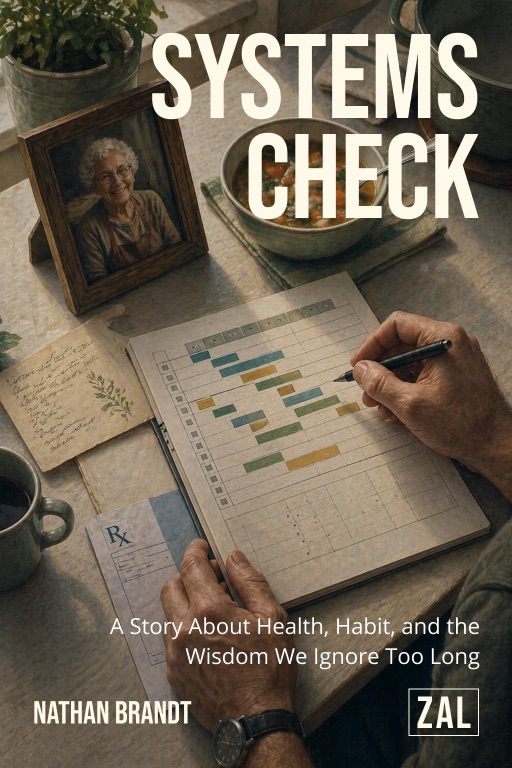
Systems Check cover

Fin's story

You'd fix it immediately if it were someone else's body.

A dry, practical story about blood pressure, weight gain, sitting down for years, and the common sense men ignore until it gets expensive.

$4.99 EPUB + PDF About 3.5 hours Coming soon

The diagnosis

The trap of ordinary decline.

Most men do not fall apart dramatically. They drift. The back pain becomes normal. The blood pressure creeps up. The coffee stops being enjoyable and becomes infrastructure. The meal deal becomes lunch by default. The body starts sending polite warnings, then firmer ones, while you keep calling it desk work, age, stress, or a busy period.

Systems Check is for the man who is not in crisis, but can see the direction of travel. It is for the man who does not need a transformation brand, a complicated protocol, or a new identity. He needs to stop breaking himself and start living with the kind of common sense he probably dismissed when someone older tried to teach it to him.

Meet Fin

A project manager gets a health warning he can no longer turn into admin.

Fin Larson is thirty-four, British, dry, and professionally good at turning chaos into a plan. Then Dr. Quinn tells him his blood pressure is 145 over 92, he has gained about a stone, and medication would be a patch rather than the solution. He leaves the appointment winded by a seven-minute walk and annoyed that his body has produced data he cannot ignore.

Three months after his grandmother's funeral, Fin starts hearing her voice everywhere: in the woman buying vegetables properly, in his mum telling him to eat, in the recipe notebook he had stopped using, and in the quiet embarrassment of realising that Gran had lived to 103 by doing the obvious things he had spent years overcomplicating.

The reframe

You do not need a transformation. You need a base.

The wellness industry often makes health feel like a personality change. Systems Check goes the other way. Fin does not become a new man. He starts eating actual food, walking, reducing pointless meetings, cooking from Gran's recipes, drinking less coffee, using movement as part of the workday, and designing systems that survive pressure.

The book's quiet argument is that ordinary maintenance is not beneath you. It is the thing that keeps the rest of your life possible. Real food, natural movement, sleep, connection, purpose, and less self-inflicted chaos are not glamorous. That is why they work.

Inside the book

What Fin's twelve weeks actually cover.

The baseline audit

Fin tracks sitting time, movement, coffee, food, meetings, back pain, and blood pressure until the pattern becomes impossible to deny.
Food without performance

The story returns to real ingredients, Gran's recipes, Sunday cooking, vegetables, proper breakfasts, and the difference between fuel and food.

Movement built into real life

Fin does not become a fitness influencer. He walks, stands during calls, experiments with walking meetings, and embeds movement into the workday.

Systems that survive pressure

Crisis weeks, deadlines, team lunches, birthdays, pubs, and tired evenings test whether the new defaults can hold when life stops cooperating.

Legacy instead of optimisation

Fin's change becomes stronger when he teaches Dave, reconnects with family traditions, and realises Gran's common sense was never primitive. It was durable.

Read a page

From The Retrospective.

Fin took the paper, thanked her, and left feeling like he'd just failed a performance review for a job he didn't remember applying for.

The walk from the surgery to the bus stop took seven minutes. Fin knew this because he was winded by minute four, which seemed both impossible and deeply unfair.

Seven minutes. He used to run 5Ks. When was that? University? Earlier? The memory felt distant, belonging to a different person who'd had functional cardiovascular system and knees that didn't click.

Where it fits

Start here if the trend is going the wrong way.

Systems Check stands on its own as Fin's dry, practical twelve-week story. It is the companion book for men whose health problem is not dramatic enough to scare them properly, but visible enough that continuing to ignore it would be dishonest.

If The Quiet Weight gives you the full map, Systems Check stays with the body at its least glamorous: blood pressure, back pain, food, walking, work defaults, social eating, sleep, and the common sense that only looks boring until it saves you.

What you may recognise

Being winded by a walk that should not wind you, and feeling both surprised and not surprised.

The appointment you have been meaning to book for longer than you are comfortable admitting.

The common sense your grandmother had that you have been overcomplicating ever since.

Coming soon

Systems Check

This one isn't out yet. Leave your email and you'll hear the day it is.

One email when Systems Check is released. Nothing else.

Related essays

Start with the problem, then come here.

Questions

Before you buy.

Is this a health programme?

No. It is a fictional story with practical sections at the end of each chapter. Fin is systematic because he is a project manager. You can take what is useful without copying his twelve-week project exactly.

Does it give medical advice?

No. The book is clear about that. If you have health concerns, talk to actual medical professionals. Fin's story is about common-sense lifestyle repair, not replacing medical care.

Is this a weight-loss book?

No. Weight changes are part of Fin's story, but the deeper subject is reversing ordinary decline: energy, movement, food, blood pressure, back pain, routine, connection, and maintenance.

What formats are included?

Systems Check includes EPUB and PDF downloads. It is also included in the complete bundle.

This is Chapter One of Systems Check.

Chapter 1: The Retrospective

The NHS waiting room smelled of antiseptic. Fin Larson sat in a blue plastic chair, watching a muted television. Tuesday morning, 9:47am, and he was already behind on meetings.

His phone buzzed. Tom from work: Quick sync after lunch?

Fin typed back: Can it be an email?

Three dots appeared. Disappeared. Reappeared.

…sure

One meeting avoided. Small victories.

“Finley Larson?” A nurse with kind eyes and sensible shoes appeared in the doorway.

He stood, grabbed his jacket, and followed her down a corridor that did nothing to settle his nerves.


Dr. Quinn smiled while delivering bad news, which Fin had always found simultaneously comforting and terrifying. She was reviewing something on her screen with the expression of someone reading a project status report where every milestone was marked red.

“So,” she said, looking up. “Blood pressure’s higher than I’d like. 145 over 92.”

Fin nodded. He’d been expecting this. Hoping against it, but expecting it.

“That’s… bad?”

“That’s stage one hypertension, at the bottom end of it. Not an emergency, but it’s not nothing, and it’s heading the wrong way.” She glanced back at the screen. “You’ve also put on about a stone since your last visit. Two years ago.”

Had it been two years? He’d been meaning to book a check-up. Life had gotten busy. Which was code for: he’d been avoiding this exact conversation.

“Right,” Fin said. “But I’m only 34. This is normal for desk work, isn’t it?”

Dr. Quinn gave him the look that medical professionals reserve for patients who are technically correct but fundamentally missing the point.

“Fin, you’re not ill. But you’re trending toward being ill. Back pain, you mentioned?”

“Lower back. It’s just from sitting.”

“How long are you sitting each day?”

He did a quick mental calculation. Morning: home office desk. Lunch: probably still at desk. Afternoon: virtual meetings, still at desk. Evening: sofa, which was basically a horizontal desk.

Working from home had seemed ideal three years ago. What it had actually meant: no reason to ever leave the flat.

“Nine hours? Maybe ten.”

“And exercise?”

“Define exercise.”

She didn’t smile. “Physical activity. Moving your body. Anything that raises your heart rate beyond walking to the kitchen for your fourth coffee.”

Fin shifted in his uncomfortable chair. “I own trainers.”

“Do you use them?”

“They’re very nice trainers. Expensive.”

Dr. Quinn sighed. It was a sigh Fin recognized from work, the one project managers made when a stakeholder had just described their completely unrealistic timeline with genuine enthusiasm.

“Here’s what I’m not going to do today,” she said, typing. “I’m not going to put you on medication off one reading in a room that makes people nervous. I’m going to give you a monitor to take home. Twice a day, a week, write them down.” She turned the screen a fraction. “If those come back where I think they will, then we talk about tablets. But medication isn’t a solution, it’s a patch. The actual solution is lifestyle changes. More movement. Better food. Less stress.”

“Right. More movement, better food, less stress.” Fin nodded like he was taking meeting notes.

She looked at him with something that might have been sympathy or might have been exhaustion. Hard to tell with GPs.

“Start small. Walk more. Eat actual food instead of whatever you’re eating now. Maybe cut down on the coffee.” She paused, looking at him carefully. “How are you managing, emotionally? The physical symptoms are clear. But exhaustion this deep, the way you’re running on empty… sometimes there’s a mental health piece too. If you make lifestyle changes for four weeks and still feel this depleted, or if it gets worse, consider talking to someone. A therapist. Nothing to be ashamed of. Sometimes the system is broken and we can fix it with movement and food. Sometimes we need actual professional support too. Both are valid.”

Fin felt something shift. Permission, maybe. To admit that fixing his body might not be enough if his mind was also struggling.

“Okay,” he said quietly. “I’ll… pay attention to that.”

“How did you, ”

“You’ve been jiggling your leg for the entire appointment. Classic sign.” She printed something and handed it over — not a prescription, a home monitoring chart, seven days of boxes waiting to be filled in. “Come back in three months. If the numbers haven’t moved, we start you on something. If they have, we won’t need to.”

Fin took the paper, thanked her, and left feeling like he’d just failed a performance review for a job he didn’t remember applying for.


The walk from the surgery to the bus stop took seven minutes. Fin knew this because he was winded by minute four, which seemed both impossible and deeply unfair. Seven minutes. He used to run 5Ks. When was that? University? Earlier? The memory felt distant, belonging to a different person who’d had functional cardiovascular system and knees that didn’t click.

He caught his reflection in a shop window,Costa Coffee, ironically,and paused. The man looking back was familiar but wrong, like a photo that had been edited by someone who didn’t quite remember what he looked like. Same face, same hair, but… softer around the edges. Heavier in the middle. Tired in a way that had become so normal he’d stopped noticing it. Dark circles under eyes that used to look alert, now just looked perpetually exhausted.

His jacket strained slightly across his stomach when he moved. When had that started happening?

When did this happen?

Not overnight. Gradually. Stone by stone, meeting by meeting, protein bar by protein bar, until looking at his reflection felt like finding out he’d been slowly morphing into someone he didn’t recognize.

His phone buzzed. Sarah from work: Free for a quick call?

Not really, he thought. Never really. But he typed: Sure, give me 5

The bus stop had a bench. Fin sat,felt his back immediately protest the angle, that familiar sharp pull in his lower back,and dialed.

“Hey!” Sarah’s voice had that particular brightness of someone who was about to ask for something. “Quick question about the client deck,do we have the competitor analysis finalized?”

He answered on autopilot, half his brain handling the question (yes, it’s in the shared drive, third tab), the other half still stuck on that reflection. When had he started looking like someone’s dad? He wasn’t anyone’s dad. He was 34. Supposed to be in his prime. Should look… well, not like this. Not soft and tired and winded from walking seven minutes.

The call ended after six minutes that could have been one Slack message. Fin sat at the bus stop, watching people walk past. Office workers heading to lunch. A mum pushing a pram, walking faster than he’d just walked from the surgery. A cyclist speeding past, effortless.

Then: a woman in her seventies with a wheeled shopping trolley, floral pattern, that specific design that seemed indestructible. She was walking up the hill,the same hill that had just left him winded,with perfect posture, back straight, steady pace, completely unbothered. Not struggling. Not pausing. Just walking like walking was a normal thing bodies did.

She was seventy-something and outpacing his cardiovascular capacity.

His gran had had a trolley exactly like that.

The thought arrived uninvited, which was how most thoughts of Gran arrived lately. Three months since the funeral. January. Cold day, good turnout, everyone saying the same things: What a life. 103! Amazing.

And it had been amazing. Gran had been vital until the end. Stayed active and independent until very late in life. Playing bridge with friends until 101. Living independently, cooking her own meals, remembering everyone’s birthdays, sharp as anything.

Their last proper conversation had been at Christmas. She’d taken one look at him across her tiny kitchen table and said, “You’re working too hard and eating rubbish, love. You’ll regret it.”

He’d laughed. Made a joke about meal deals being perfectly adequate. She’d given him the look, the one that said she knew he was talking nonsense but was too polite to call him out properly.

“I’m serious, Fin. You keep going like this, you’ll be broken by fifty.”

“Gran, I’m fine. It’s just busy at work.”

“Busy.” She’d shaken her head. “Your generation thinks busy is an achievement. It’s not. It’s just busy.”

He’d changed the subject. Something about work, probably. She’d let him, but the look hadn’t left her eyes.

Now, sitting at the bus stop with a folded monitoring chart in his pocket, Fin realized what that look had been.

Disappointment.

Not in him, exactly. In what he’d chosen to ignore.

Gran had lived long and well eating roast dinners and moving naturally. Proper food, regular movement, nothing fancy. Just… normal life.

Meanwhile, he was declining at 34 on protein bars and seventeen meetings per week, half of which could have been Slack messages.

The bus arrived. Fin stood, felt his back complain again, and climbed aboard.

What would Gran say?

He knew exactly what she’d say. She’d already said it. He just hadn’t listened.