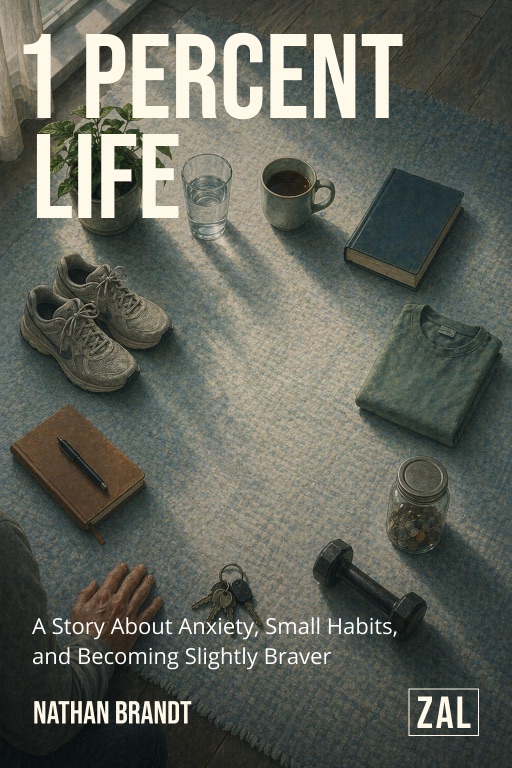
The problem: You know what to do. You start. It goes well for a while. Then a normal bad week ends it, and you read the ending as evidence about yourself.
You have started before. That is the part that makes this one hard.
Most advice on how to get out of a rut assumes you have not tried. You have. Repeatedly. That is precisely the problem you are actually solving for.
The gym membership, the early mornings, the reading, the budget, the app, the routine you built on a Sunday evening with genuine intent. Each one worked. That is worth saying clearly, because men in this loop tend to remember only the endings: each one worked for a stretch, sometimes weeks, occasionally months.
Then something ordinary happened. A bad run at work. Four nights of poor sleep. A weekend away. Illness. Nothing dramatic — just a week where the conditions were not ideal. And the thing stopped, and it did not restart, and a few months later you found yourself reading about starting again.
The internet’s answer to this is that you gave up. “If you’re tired of starting over, stop giving up.” It is on a hundred motivational posts and it is worse than useless, because it names the symptom as the cause and leaves you with nothing to do except try harder at the exact thing that has not worked.
The plan was too big, and it was always going to be
Here is the mechanism nobody mentions.
When you decide to change something, you set the size of the change while motivated. That is the only moment you would ever agree to it. On the Sunday evening, with the plan in front of you, six days a week feels reasonable. An hour feels reasonable. Starting at 6am feels reasonable.
But the plan does not get executed on Sunday evening. It gets executed on a Wednesday in month two, after a bad meeting, on five hours’ sleep, with something unresolved at home. That is the real operating environment, and the plan was never designed for it.
So it breaks. Not because you are undisciplined — because the specification was written by a version of you who was rested, optimistic, and not yet dealing with anything.
Every plan you have ever abandoned was set at a size you could sustain in good conditions. Life does not supply good conditions on a schedule.
Why the collapse feels like a verdict
If the plan were just a plan, its ending would be a scheduling matter. You would adjust it and carry on.
It does not feel like that. It feels like information about you. Each abandoned attempt joins a file, and the file has a conclusion written on it: you are someone who does not follow through. By the fourth or fifth restart, that conclusion is doing more work than any of the plans ever did.
This is why the restarts get harder rather than easier. It is not that you have less energy. It is that starting now costs more, because starting means opening the file again and betting against the evidence.
Men in this position often stop starting altogether and call it realism.
The thing that actually breaks first
Watch the sequence closely and it is rarely the main activity that goes first.
Sleep goes first. Or the meals stop being cooked. Or the walk disappears because there is too much on. The infrastructure that made the plan possible gets cut to buy time for the pressure, and then the plan collapses a week or two later and takes the blame.
You did not fail at the gym. You failed to sleep, and then the gym became impossible, and then the gym became the thing you had failed at.
This matters because it changes what you protect. Under pressure, most men cut recovery to protect output. It is exactly backwards, and it is the single most reliable cause of the restart loop.
One thing to try
Take whatever you are planning to start and halve it.
Then halve it again.
Keep going until you reach a version you could still do on the worst Tuesday of this month — not an average day, the worst one. Bad sleep, bad mood, too much on, nothing going right. If it would not survive that day, it is still too big.
What you end up with will feel insultingly minor. Ten minutes. One page. One walk. One proper meal a week. Something so small that it seems not worth doing.
Do that instead.
The size is not a compromise you are making because you are weak. It is the correct size, because it is the only size that has any relationship with your actual life. A plan that only works in good conditions is not a plan. It is a mood.
Small is the only thing that compounds
The objection is obvious: ten minutes will not change anything.
Ten minutes done for a year changes considerably more than an hour done for three weeks, four separate times, with three months of nothing in between and a worsening story about your character running underneath. That is the real comparison — not small versus large, but small versus the loop.
There is also a second effect, which matters more than the first. When the thing is small enough to survive a bad week, bad weeks stop being endings. You have a hard Wednesday and you still do the ten minutes, badly, and nothing breaks. Do that a few times and the file starts to close. You are no longer someone who does not follow through. You are someone who kept going through a rough patch, which you can now prove.
That is the actual asset. Not the ten minutes. The evidence.
You will still have bad weeks
The plan is not to eliminate them. The plan is to build something that does not require their absence.
Expect the week where you do the minimum badly and resent it. Expect the week where you miss two days. Missing two days is not a restart — it is two days. The restart only happens when you decide the whole thing is over and go back to reading about it.
The men who get somewhere are not the ones with better weeks. They are the ones whose version of the thing was small enough that a bad week could not kill it.
Where to go next
This article gives you the halving test. The 1 Percent Life is Phillip’s story — a man who researched change more thoroughly than most people who have already made it, and who gave himself twelve months of one-percent changes instead of one more overhaul. The Quiet Weight is the wider map, including the chapter on why change built for an audience rarely lasts past the point where anyone is watching.
One thing to try
Halve the plan. Then halve it again. Keep halving until it would survive your worst week of the month.
A sentence you can use
I'm not starting again. I'm doing a smaller version that I can still do when things go wrong.
Where to go next
If this is the room you are in, start with the book that goes deeper into the pattern without turning it into a performance. Start with The 1 Percent Life.