The problem: A private measurement has become louder than real intimacy.
Size anxiety is cruel because it can live almost entirely in private. A man can go to work, make jokes, train, date, pay bills, and still carry a secret measurement that feels louder than the rest of his life. He may know the fear is disproportionate. He may have read the statistics. He may even have been reassured by partners. None of that necessarily stops the thought from returning at the worst possible moment.
That is the part outsiders often misunderstand. The anxiety is not only about a body part. It is about the meaning attached to it. Worth. Masculinity. Comparison. Being laughed at. Being found wanting. Being remembered for the wrong reason.
The number becomes a verdict
Size anxiety turns measurement into identity. The man is no longer asking, “What is true about my body?” He is asking, “What does my body prove about me?”
Once that question takes over, intimacy becomes difficult. Instead of being with another person, he starts watching himself from the outside. Is she disappointed? Is this enough? Is that comment a clue? Is this position safer? Should I avoid the situation completely before anyone can confirm the fear?
The deeper issue is usually not the number. It is the belief that masculinity can be inspected and withdrawn. One comparison, one comment, one look, one old joke, one porn-shaped idea of what sex is supposed to look like, and the whole self feels up for review.
That is why reassurance often does not hold. Reassurance can help in the moment, but if the underlying belief remains untouched, the anxiety simply asks for the same reassurance again next week. The problem is not that the man has not heard enough comforting sentences. The problem is that shame has become the judge.
Where the standard came from
Male size anxiety is not a natural human tendency. It was constructed, primarily through pornography, locker-room culture, and a broader male environment in which admitting insecurity was more dangerous than performing certainty.
The average man’s reference points for what counts as adequate are systematically distorted. Pornography selects for extremes and presents them as normal. Locker-room culture translates insecurity into mockery and comparison. The silence around male sexual anxiety means that most men assume they are the only one carrying this particular fear, which amplifies it.
By the time a man reaches adulthood with this fear, he has rarely been given accurate information, honest male conversation, or a context where the anxiety could simply be named and normalised. Instead, the fear has often been confirmed, exaggerated, or driven further underground.
That origin matters because it means size anxiety is not a verdict delivered by reality. It is a verdict delivered by a distorted education. The gap between what is actually happening in the room and what the anxiety insists is happening can be enormous.
The avoidance it creates
Size anxiety does not usually stay private. It shapes behaviour in ways that compound over time.
Some men avoid situations where they might be exposed to judgment. Others compensate with bravado — becoming sexual in ways that are about performance rather than contact. Some develop a kind of pre-emptive withdrawal in relationships, keeping an emotional distance that ensures they are never fully seen.
The common thread is that the anxiety starts making decisions. The man is no longer responding to the actual person in front of him. He is managing the fear. And that management can take up so much space that genuine intimacy — the kind that requires being present, curious, and somewhat undefended — becomes nearly impossible.
Porn and comparison make the room smaller
For many men, the private standard was not built from real sexual experience. It was built from fragments: porn, locker-room exaggeration, jokes, online forums, old comments, and the silence around ordinary male insecurity. The result is a distorted classroom where nobody admits they are also scared.
That distortion can follow a man into real intimacy. A real person in bed with you becomes less visible than the imagined audience in your head. Instead of responding to warmth, pleasure, humour, affection, and feedback, you respond to the fear of being assessed.
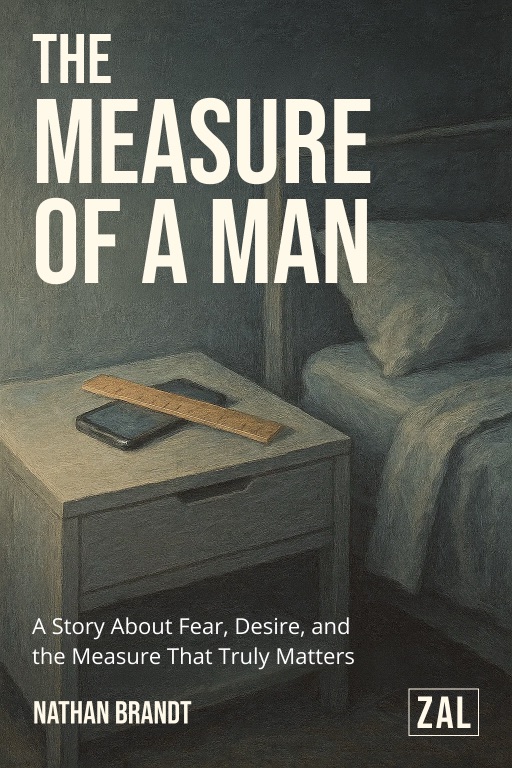
The Measure of a Man follows men living under different versions of this pressure. The route out is not endless proof. It is reality, communication, patience, and intimacy that is not built around performance.
One thing to try
Ask what you believe the number proves. Do not answer quickly. Write it down.
Maybe the sentence is: “It proves I am not enough.” Or: “It proves I will be compared.” Or: “It proves I am not really masculine.” Once the belief is visible, ask the next question: who taught you that proof was required?
This is not a trick where the fear vanishes because you wrote it down. It is a way of moving the fear from absolute truth to learned belief.
Where to go next
This article names the pattern and gives one way to separate body fact from shame verdict. The deeper work includes sexual anxiety, porn, secrecy, communication, and learning how to be with another person without turning the room into a courtroom. The Measure of a Man is where that story goes further.
One thing to try
Ask what you believe the number proves. Then ask who taught you that proof was required.
Where to go next
If this is the room you are in, start with the book that goes deeper into the pattern without turning it into a performance. Start with The Measure of a Man.